Transgressing social boundaries, creating everyday utopias
In Everyday Utopias Davina Cooper writes about "networks and spaces that perform regular daily life.....in a radically different fashion." 1 She goes on to say that these spaces work "by creating the change they wish to encounter [by] building and forging new ways of experiencing social and political life."
Perhaps this is a big claim to make on the Patridiot 10-day Summer School that was created outside Lucerne, but I believe it was a step along the journey. [This blog runs parallel and in tandem with the blog post by my partner-in-pranks-&-play, Robyn robynhambrook.com and hopefully reading both of these offers a nicely three-dimensional account account of what happened during the 2026 Summer School]
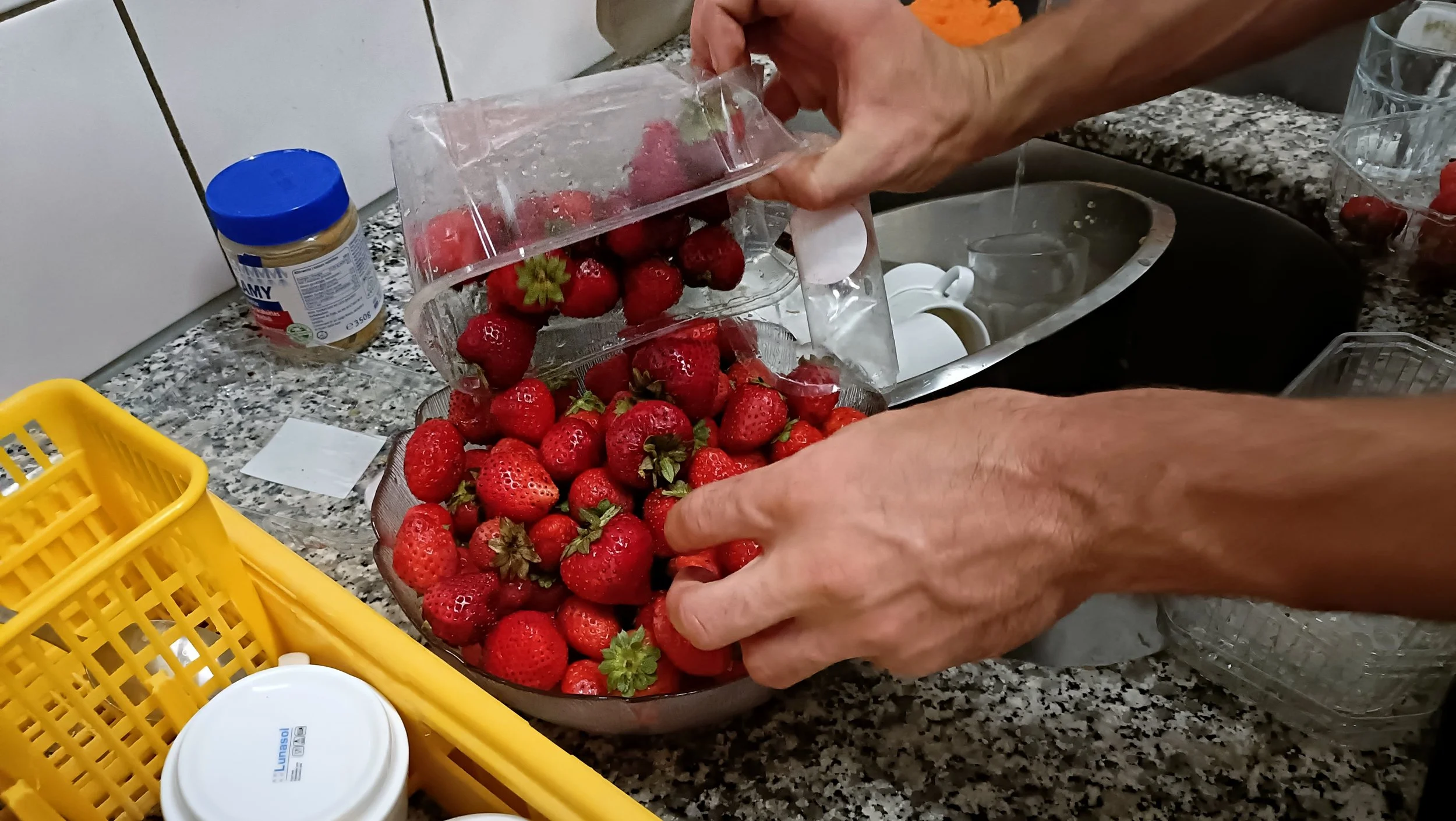
Rescued food from one of the night-time dumpster-diving trips
Cooper argues that there are two contrasting principles that engaged her in her research: "on the one hand, the everydayness of being imperfect, near at hand, with rules and established ways of doing things; on the other, the utopian quality of being experimental, innovative, and intent on prefiguring a better world." We might use these broadly to look at the way the 10-day Patridiot Summer School was organised and how it developed.
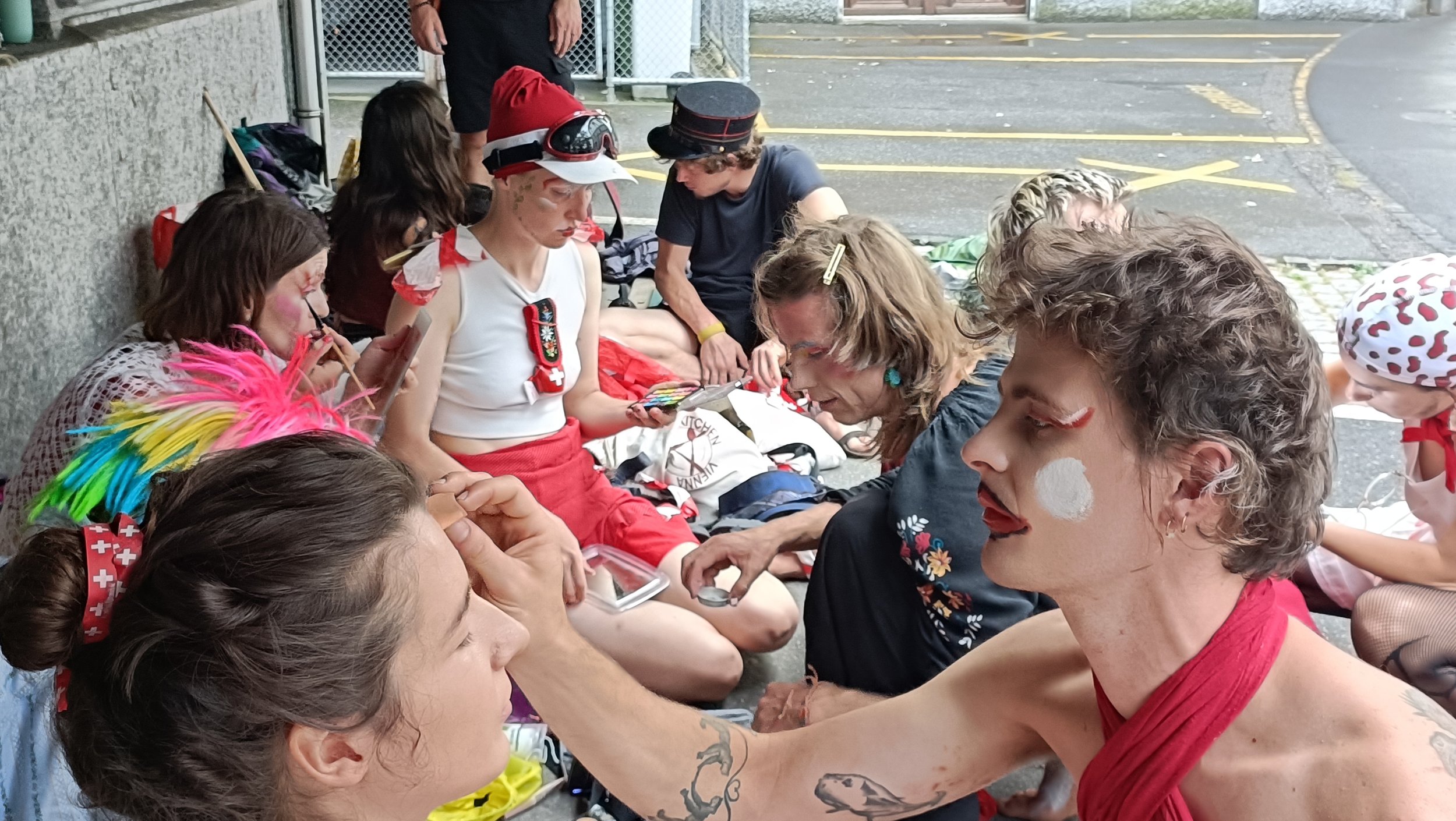
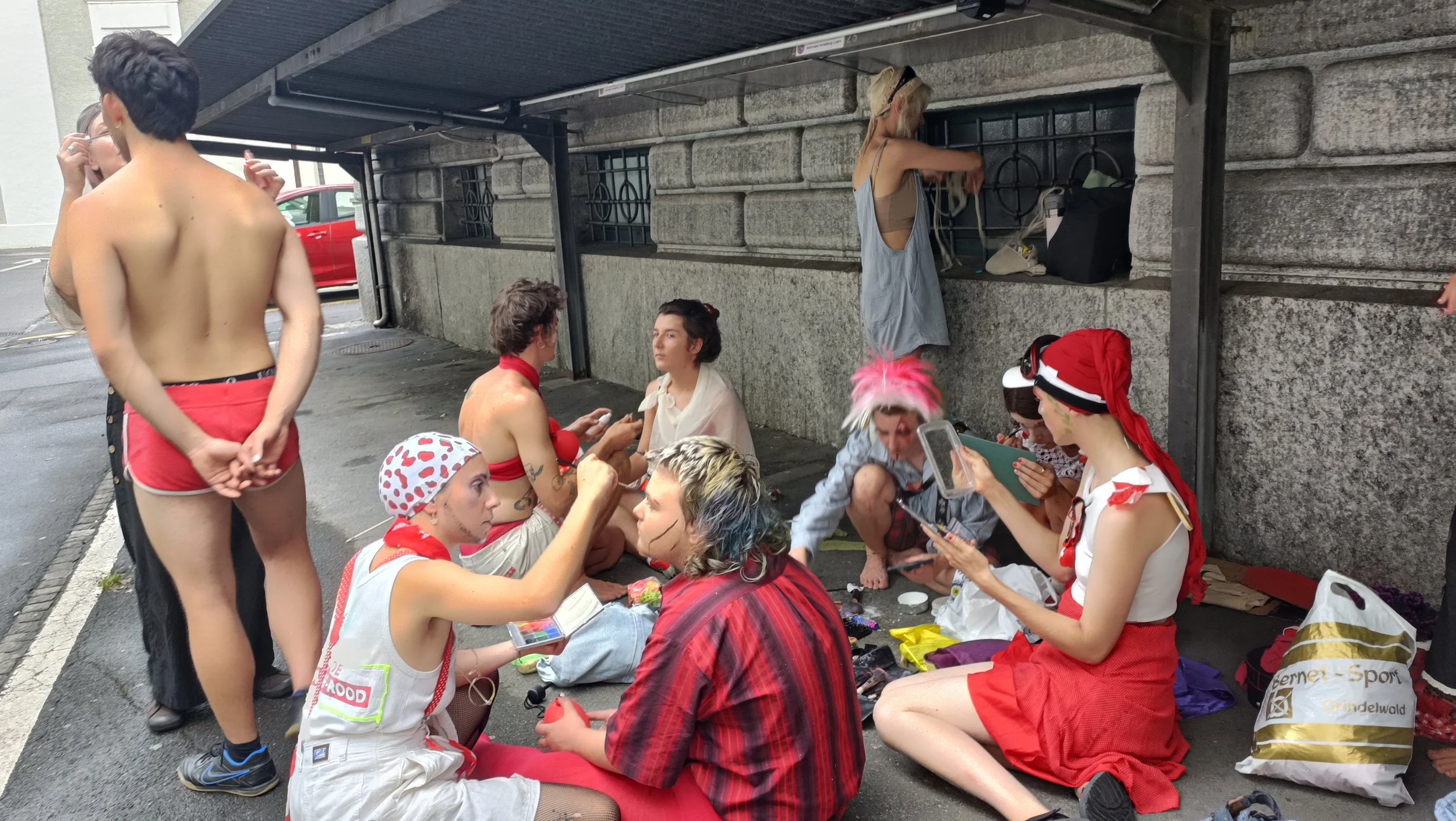
Preparing for the Patriot Day parades (and playful, provocative protests!!)
Near at hand (The location)
The Nomadic Rebel Clown Academy (Robyn Hambrook and I) was collaborating for a second year, with Clownlabor Schweiz & TdU (Theater of the Oppressed Vienna) and the training was similarly organised: we had a hostel to ourselves, in a sizeable plot surrounded by woodland, a 15-minute walk into a small rural town, Malters, which is a ten-minute train journey from Lucerne. There was a medium-sized common room, dormitories and showers, 2 rooms for facilitators (Robyn and I bagged those!) plus a room that began as a space for silent inhabiting but then became a place to sleep for those who needed more quiet around them during the nights. Some chose to sleep outside in the woods, or in the field, one slept in a tent above the picnic table area outside the back of the hostel. There was a small field next to a gravel parking lot over which we rigged tarpaulins to create shade and that became our general gathering place for the morning ritual as well as being used for the first two days of games and exercises and importantly for the evening cabaret programme, spontaneously organised by several clowns and stretching into the early hours {When will we do bouffon?}
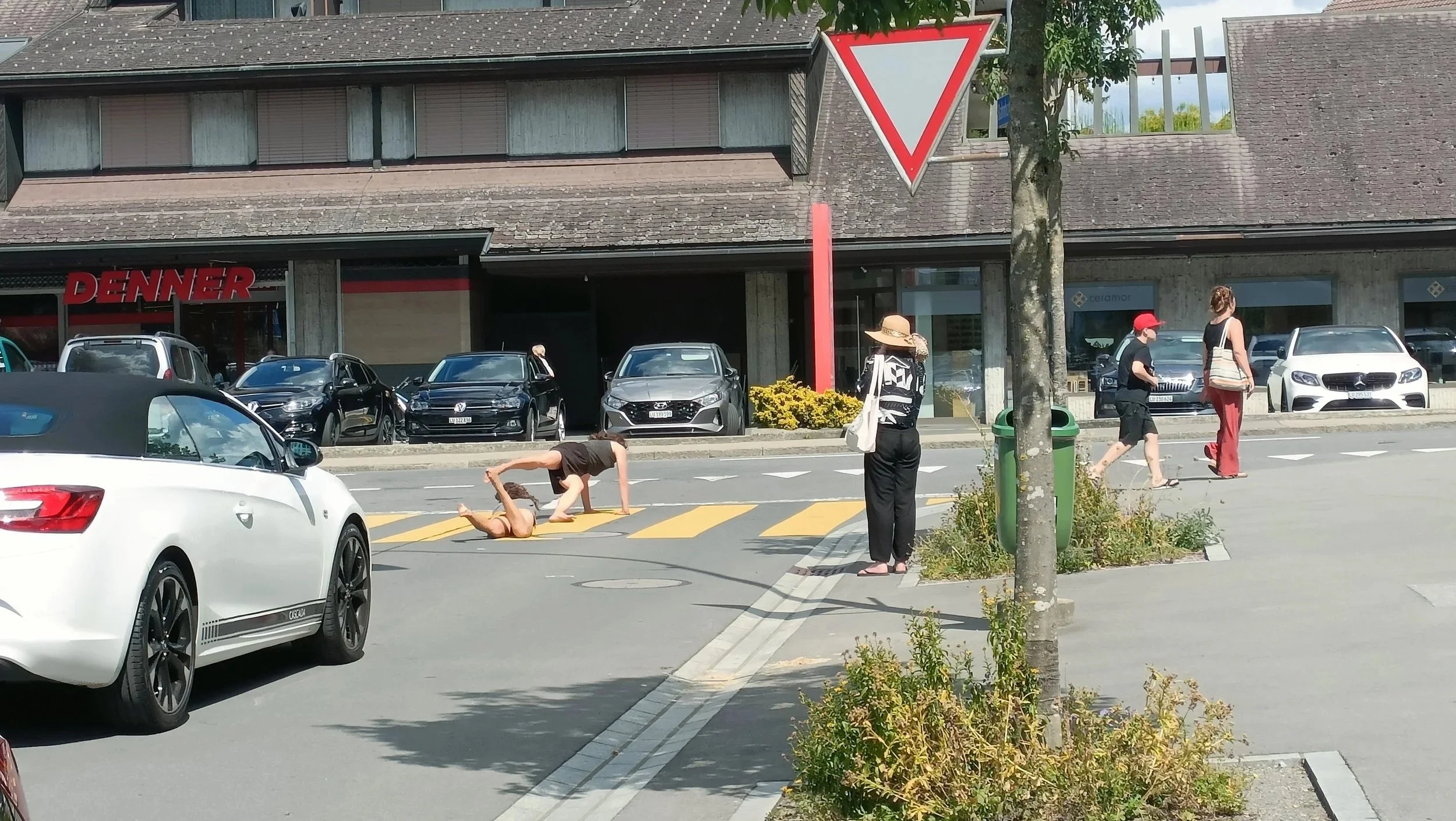
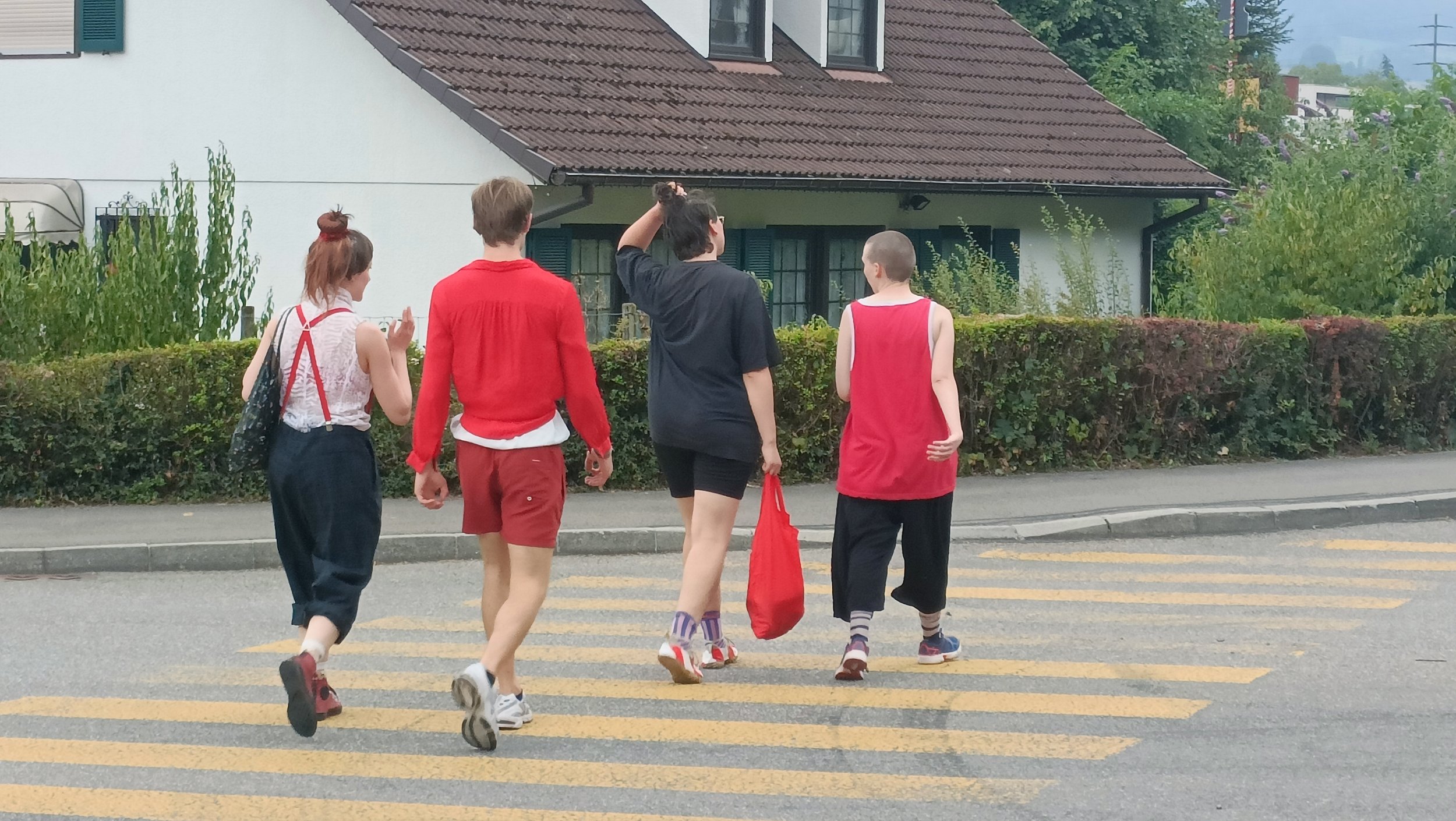
New ways of crossing the road in Malters
There were two kitchen staff for 28 eaters - and big ones at that, we all seemed to get very hungry! - participants took one washing-up shift (there were efficient dishwashing machines) and signed up for two other cleaning shifts that kept common spaces, dormitories, toilet and shower areas clean - not an easy task (in spite of having a no-shoes indoors policy) when we are coming in and out, tracking earth, twigs, grasses and leaves.
I'm taking a bit of space/time to describe these elements because for me they are becoming necessary conditions to creating what I feel is a workable, creative and supportive model for a temporary 'everyday utopia' for arts activism, in this case, our collaborative rebel clowning Summer School.
Rules and Established ways of doing things. (The schedules)
As in the previous year, the Clownlabor/TdU team facilitated the introductory evening session and the following day with games and exercises designed to get people feeling comfortable with each other (establishing parameters for physical contact, setting out the general 'rules' of living and working together, introducing a buddy system, the daily plenary session, and getting familiar with each others' chosen pronouns) thus developing the first threads of trust between us. {I'm so looking forward to doing bouffon}.
We created a pretty rigorous & tight daily schedule - breakfast from 8 am, 9.15 morning ritual preceded by the song alarm "Why so Serious?" 9.30 - 12.30 work session, 12.30 - 14.30 lunch, rest and recalibrating, 14.25 "Why so Serious?" 14.30 - 17.30 work session, followed by 30 mins reflection with your buddy, plenary from 18.15 - dinner from 19.00. Evening sessions of our presentations and wonderfully spontaneously organised cabaret, dumpster diving (for food left out by the local Denny's) and other evening offerings happened after 20.00 and into the night.
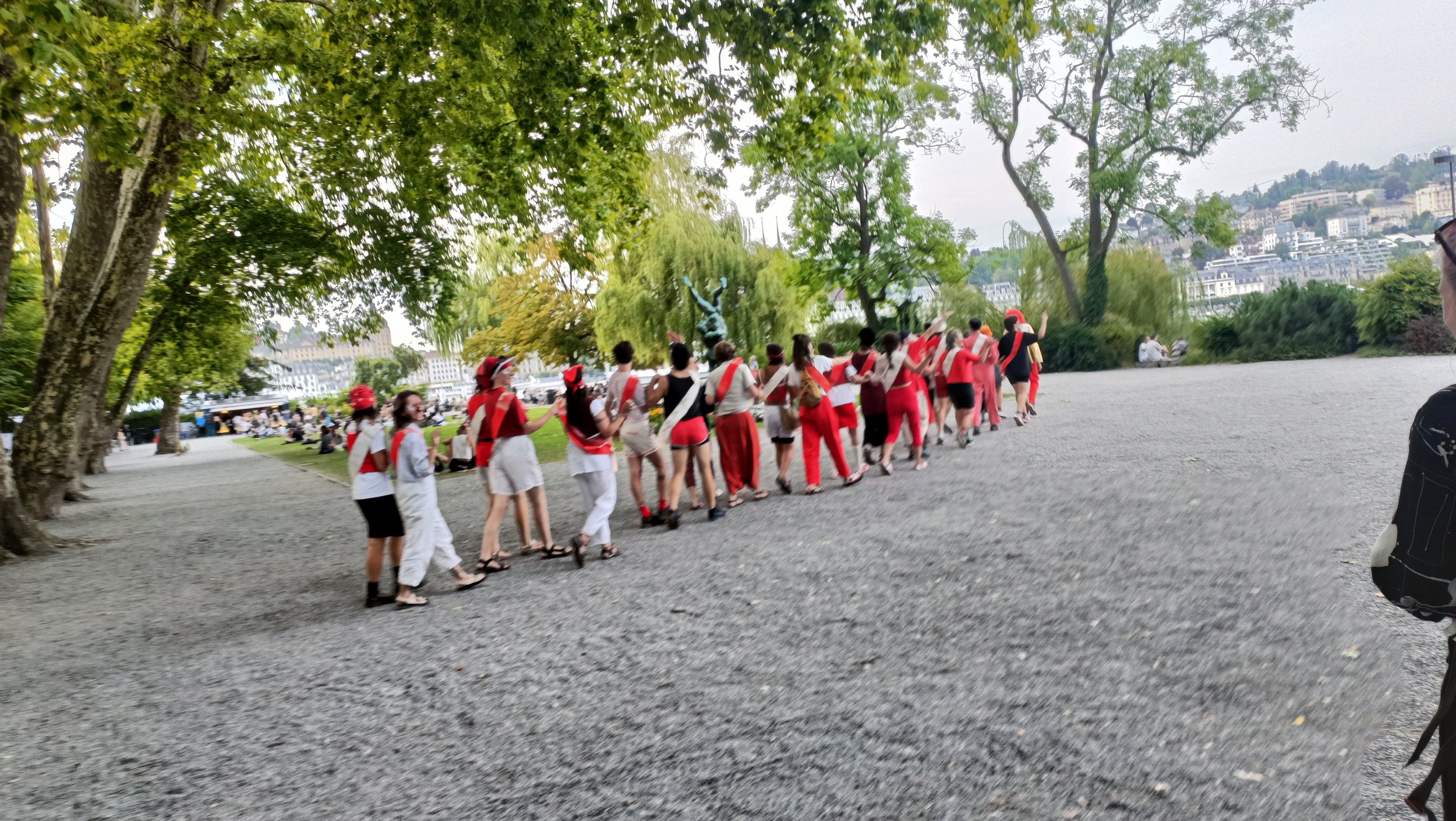
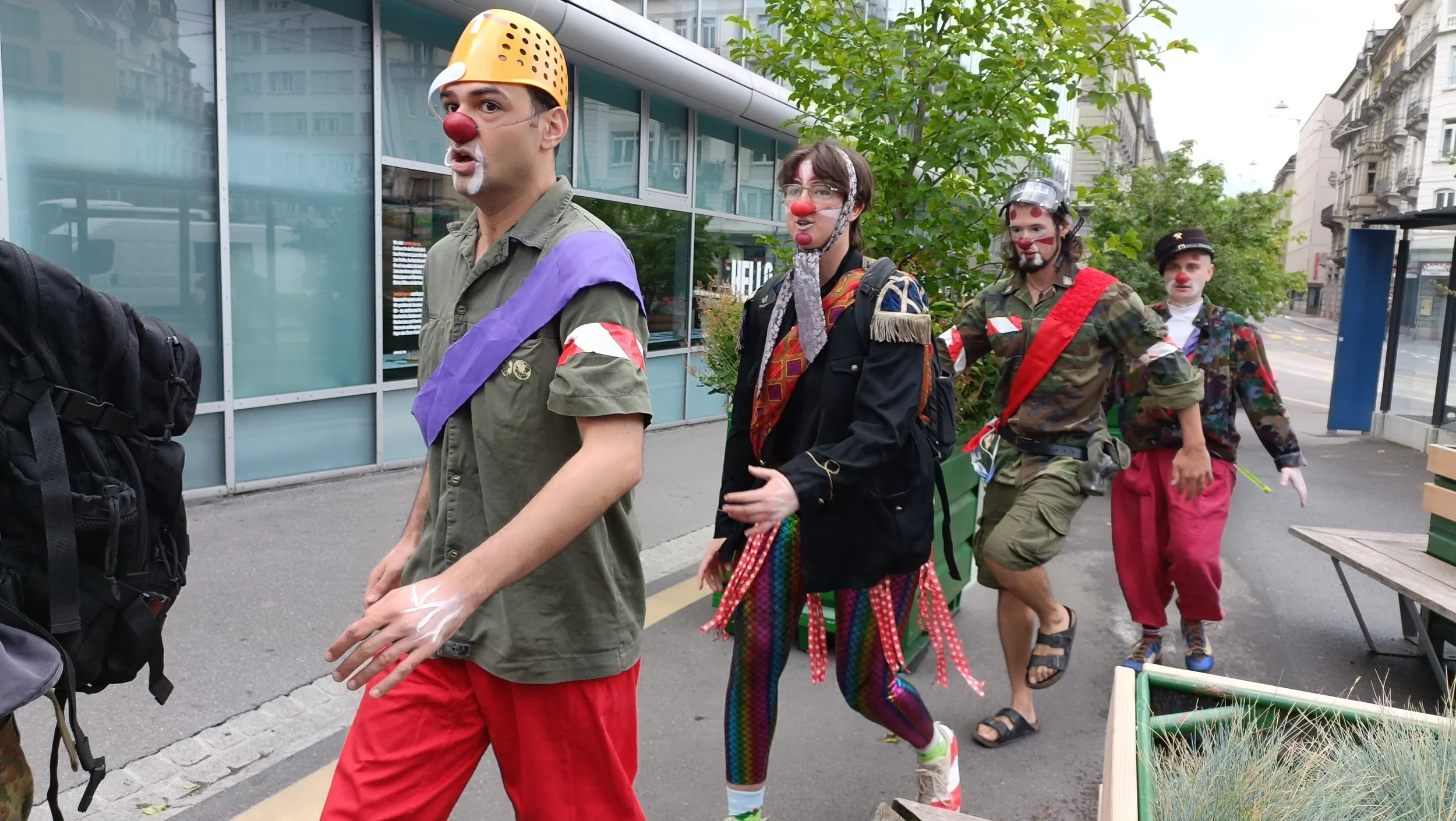
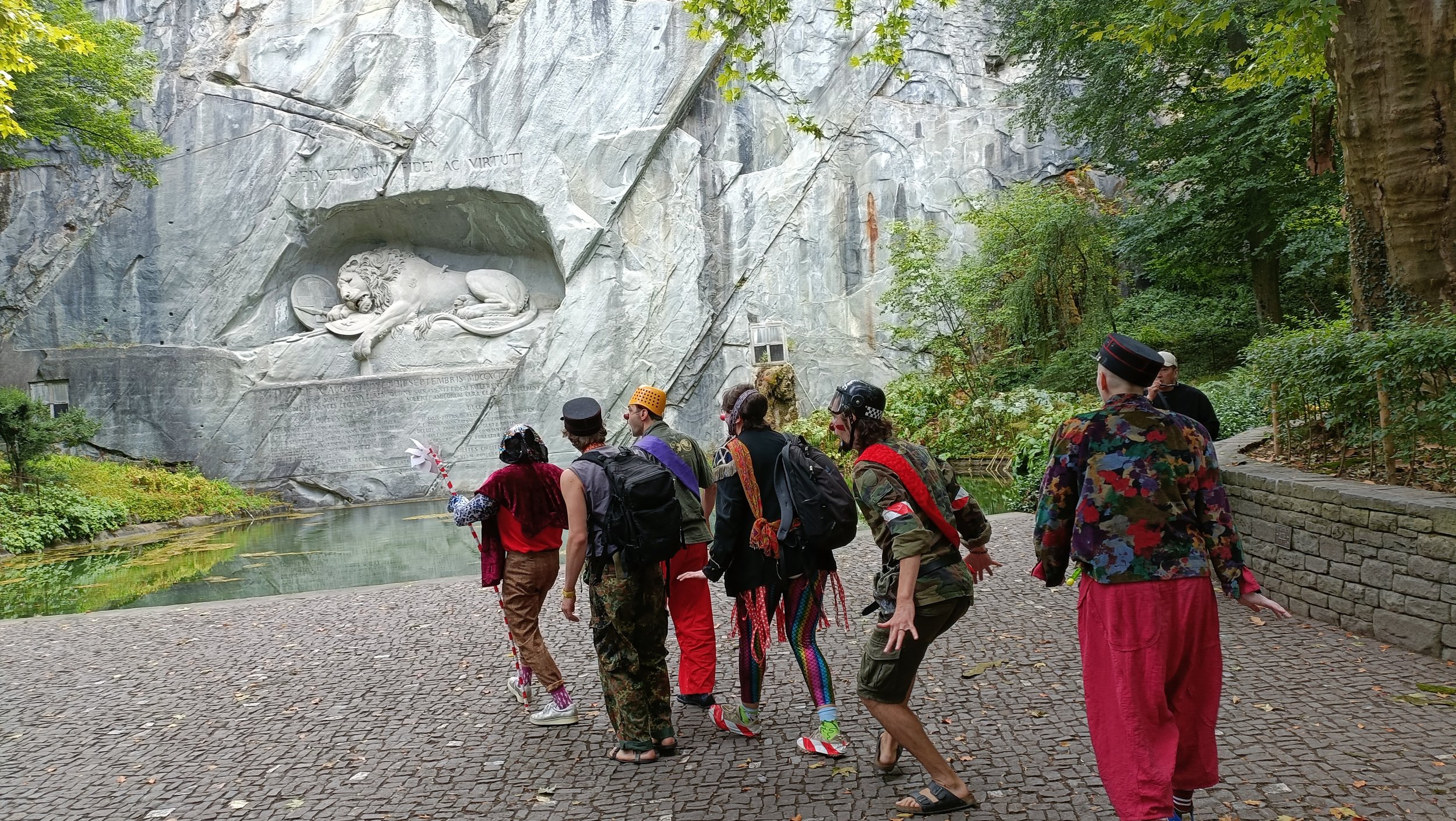
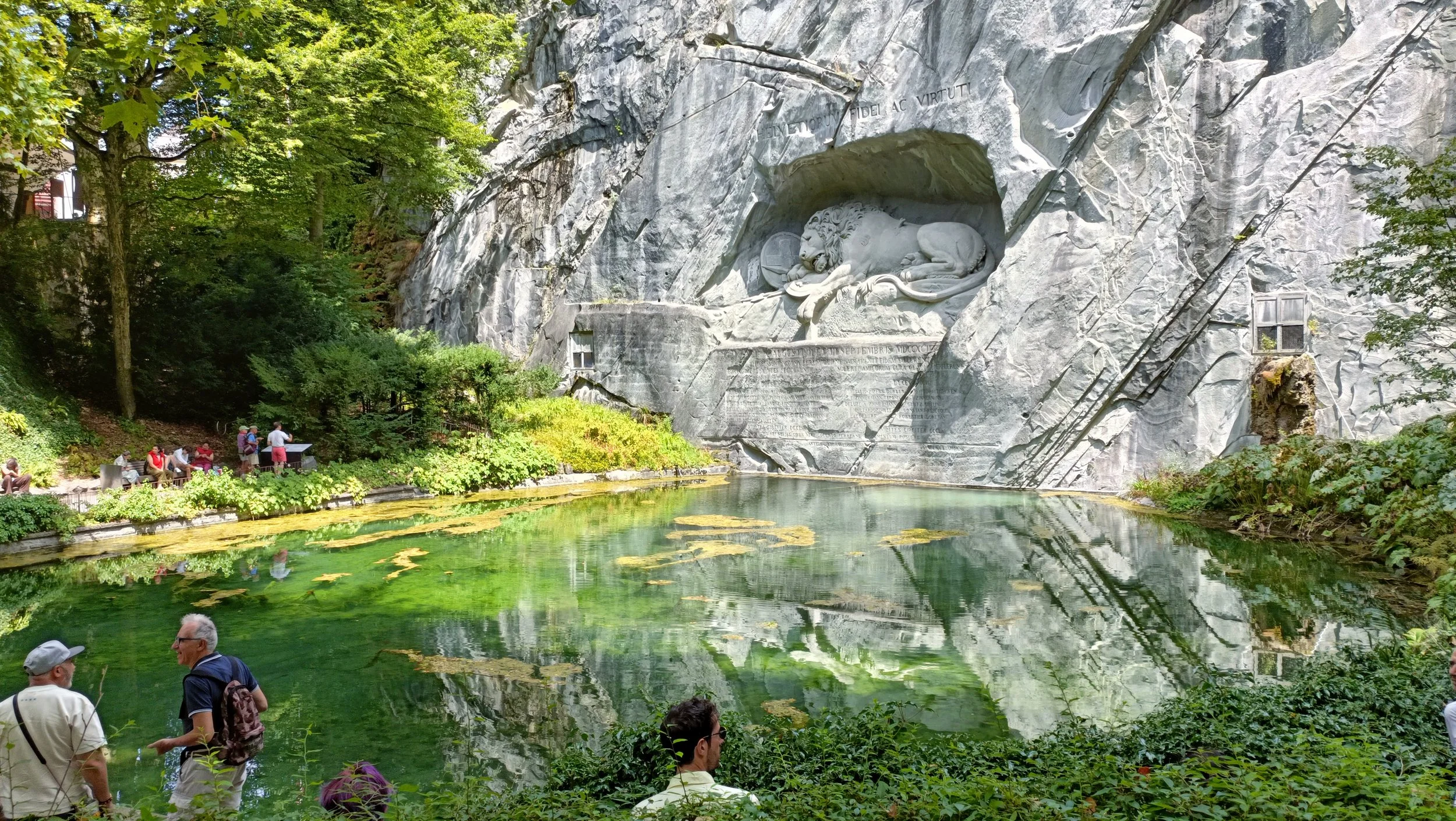
Robyn and I took over facilitation with our Rebel Clown training on the second full day. Having three extra days felt luxurious at the outset and we were able to take a little more time on separate basic clown and bouffon games and exercises in these first two days. The organising team had expressed a wish to work in smaller groups for a longer time in order to build trust and understanding for the performative actions on July 31st and August 1st (Swiss Patriot Day). We wanted to explore ways of creating groups fairly quickly, without spending too much time in lengthy discussions and used spectrum lines with topics such as experience of street action and how much do you want to provoke as opposed to create light, playful disruptions, plus a potentially difficult issue of risk and how much are you willing to put yourself in a position of potential arrest. Participants grouped themselves accordingly, and fairly organically without much hesitation on the first day... and these topics were discussed further beyond the working sessions in more casual conversations and discussions.
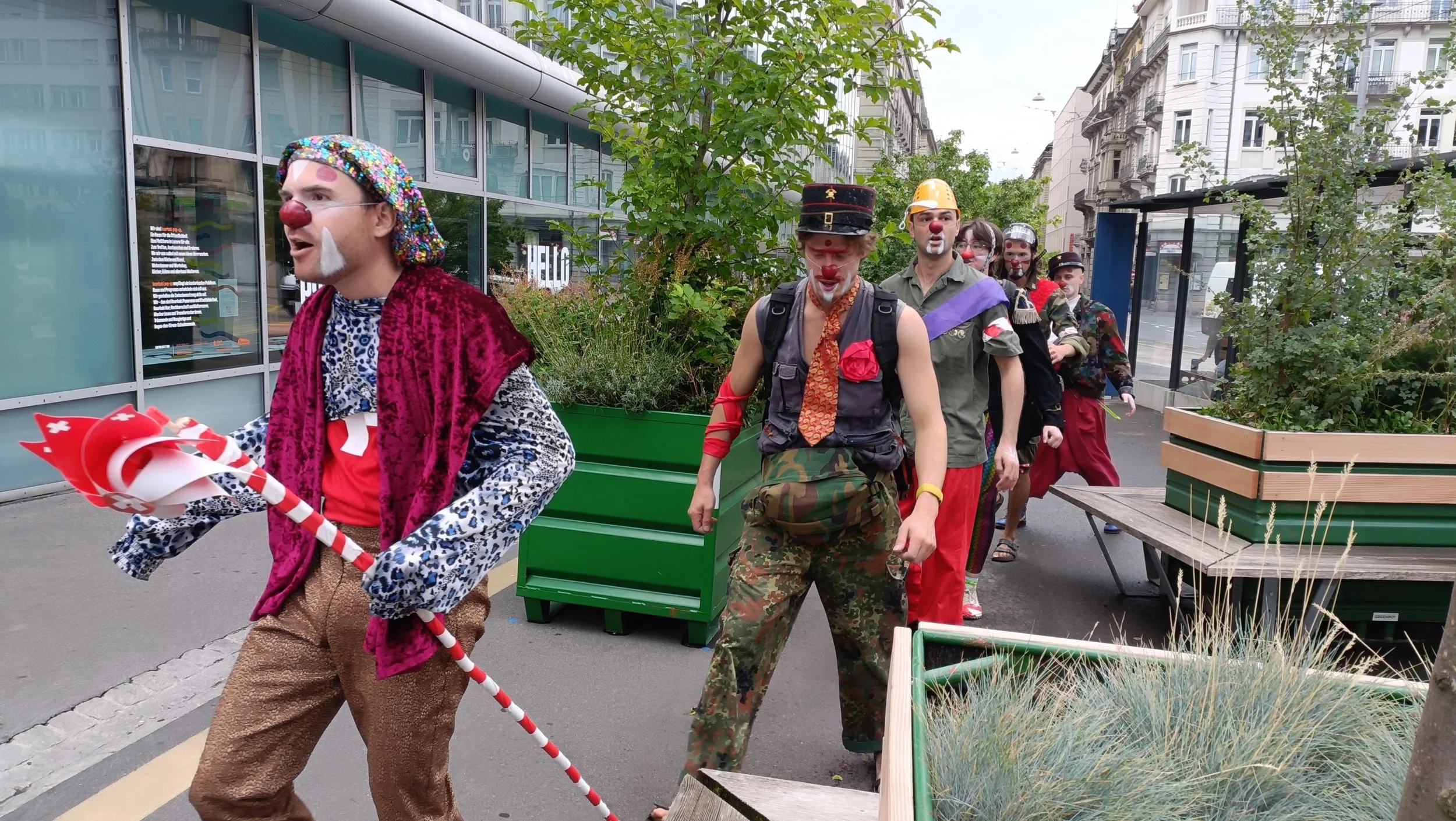
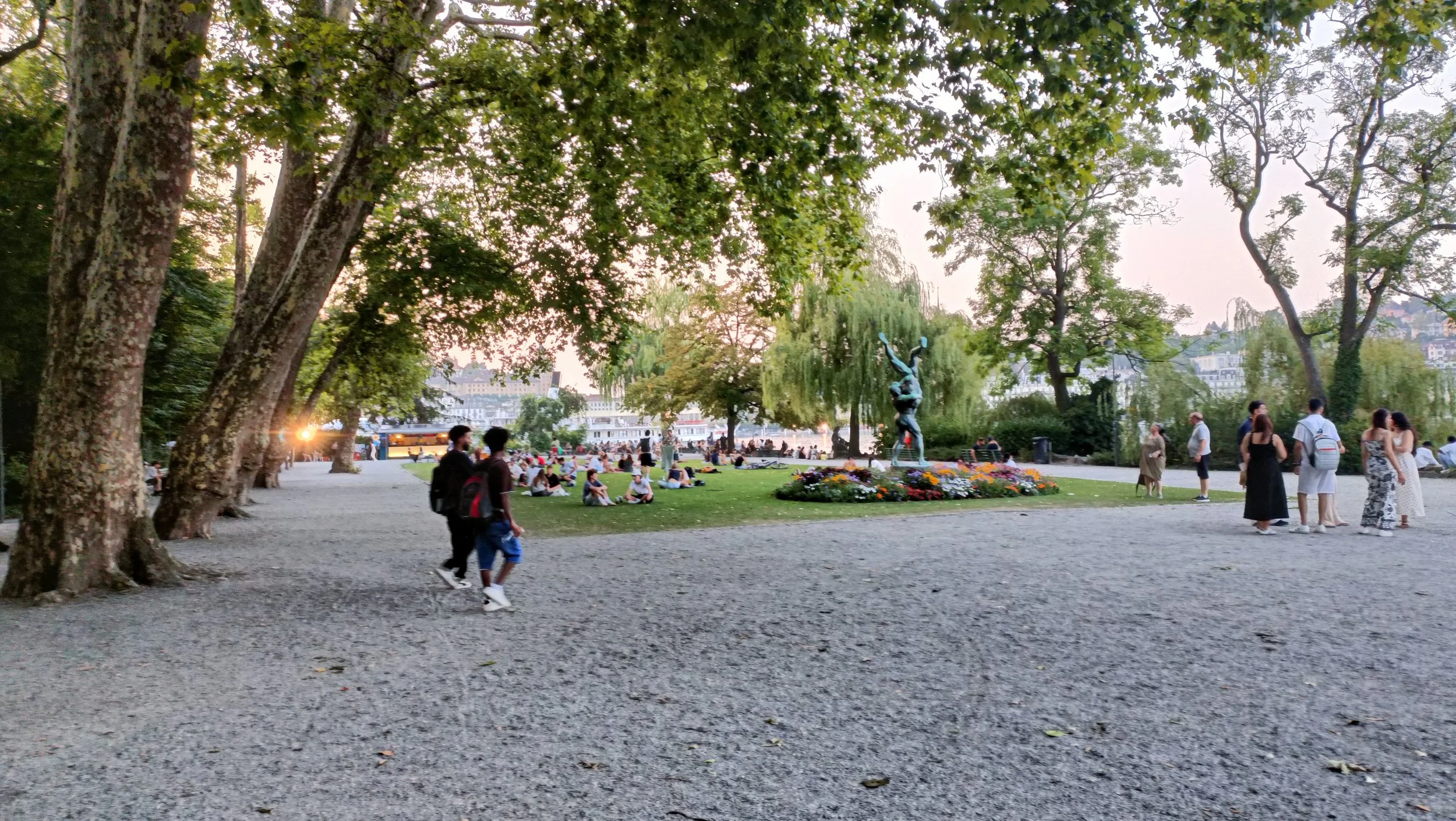
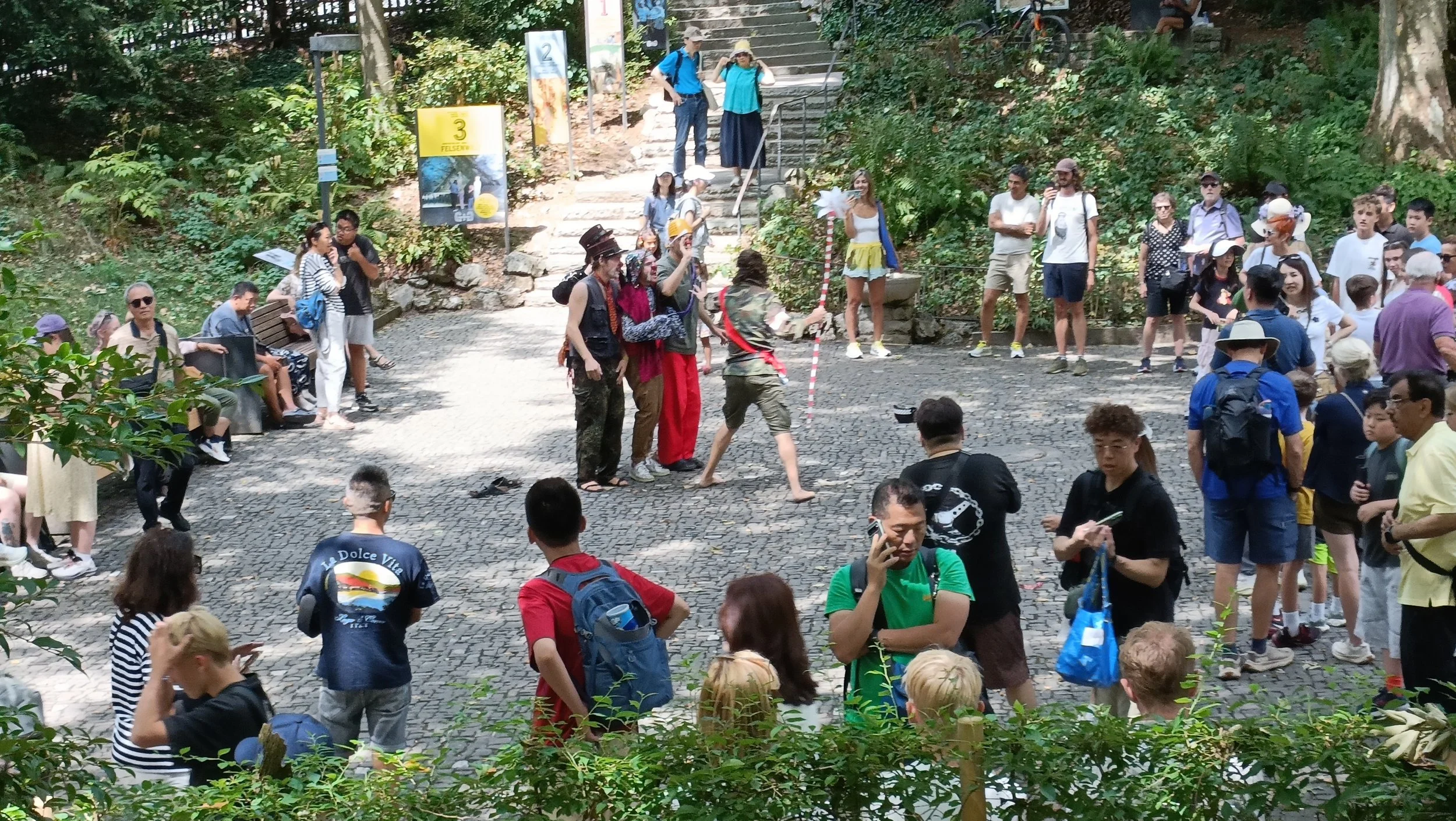
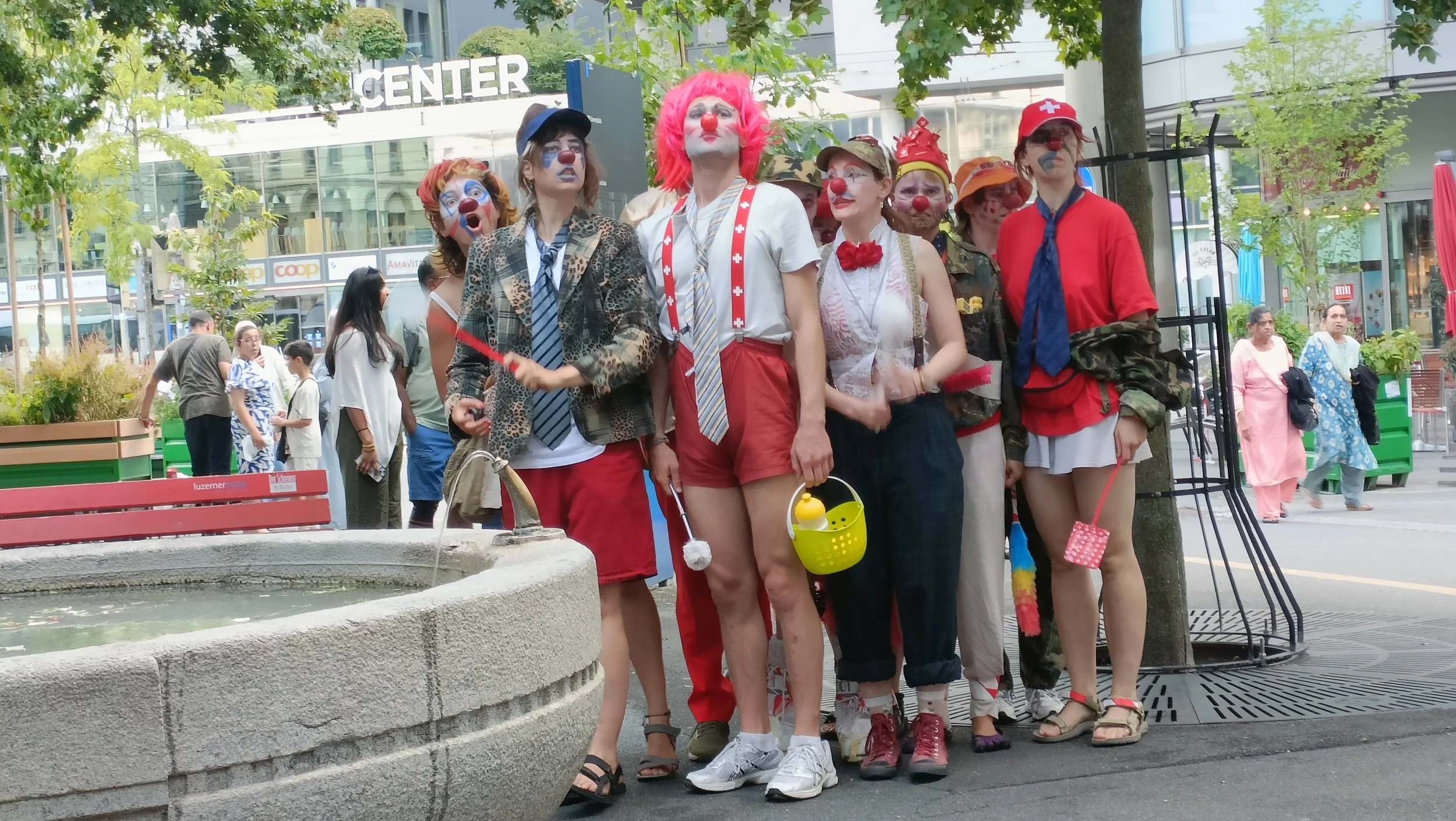
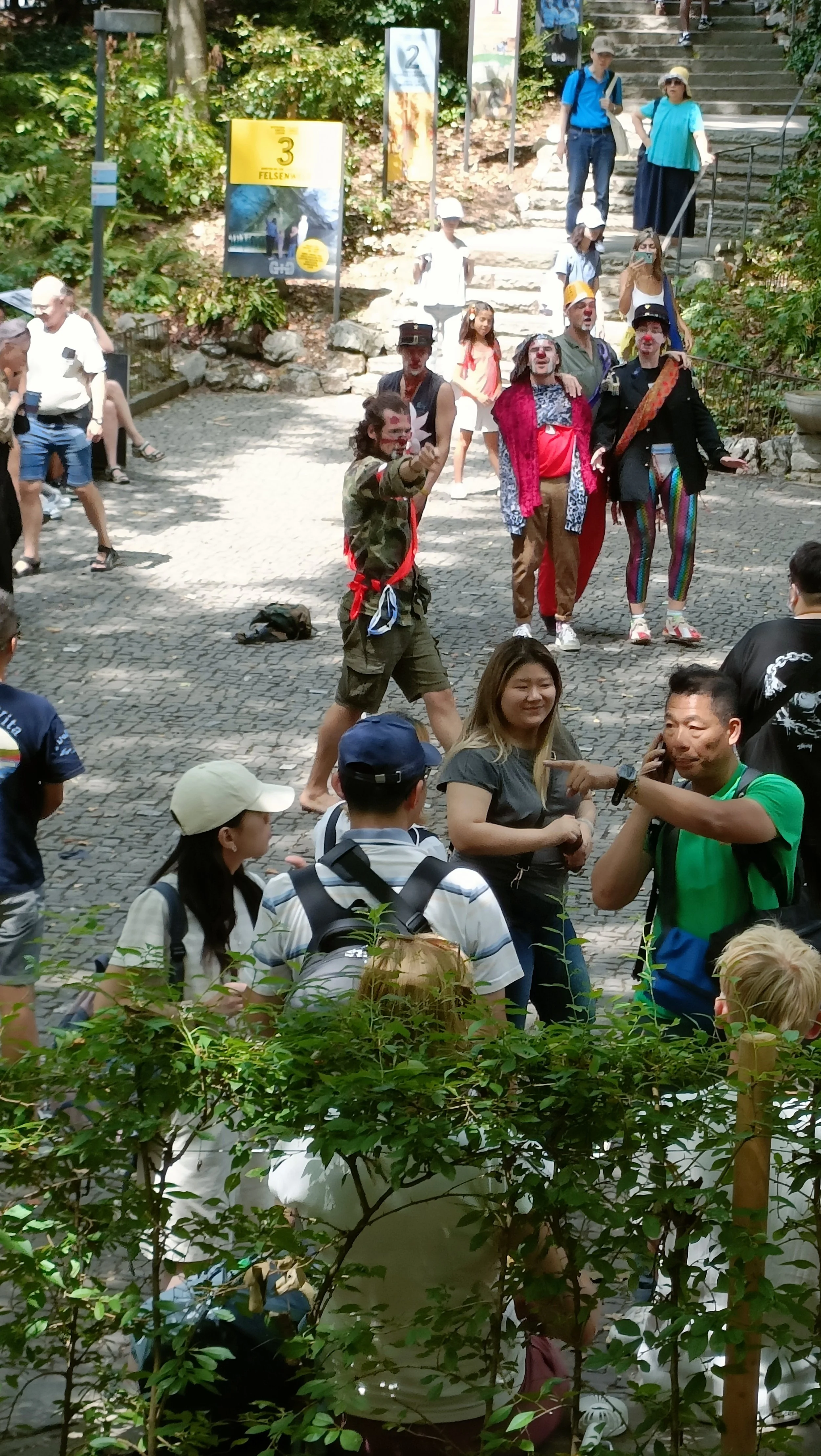
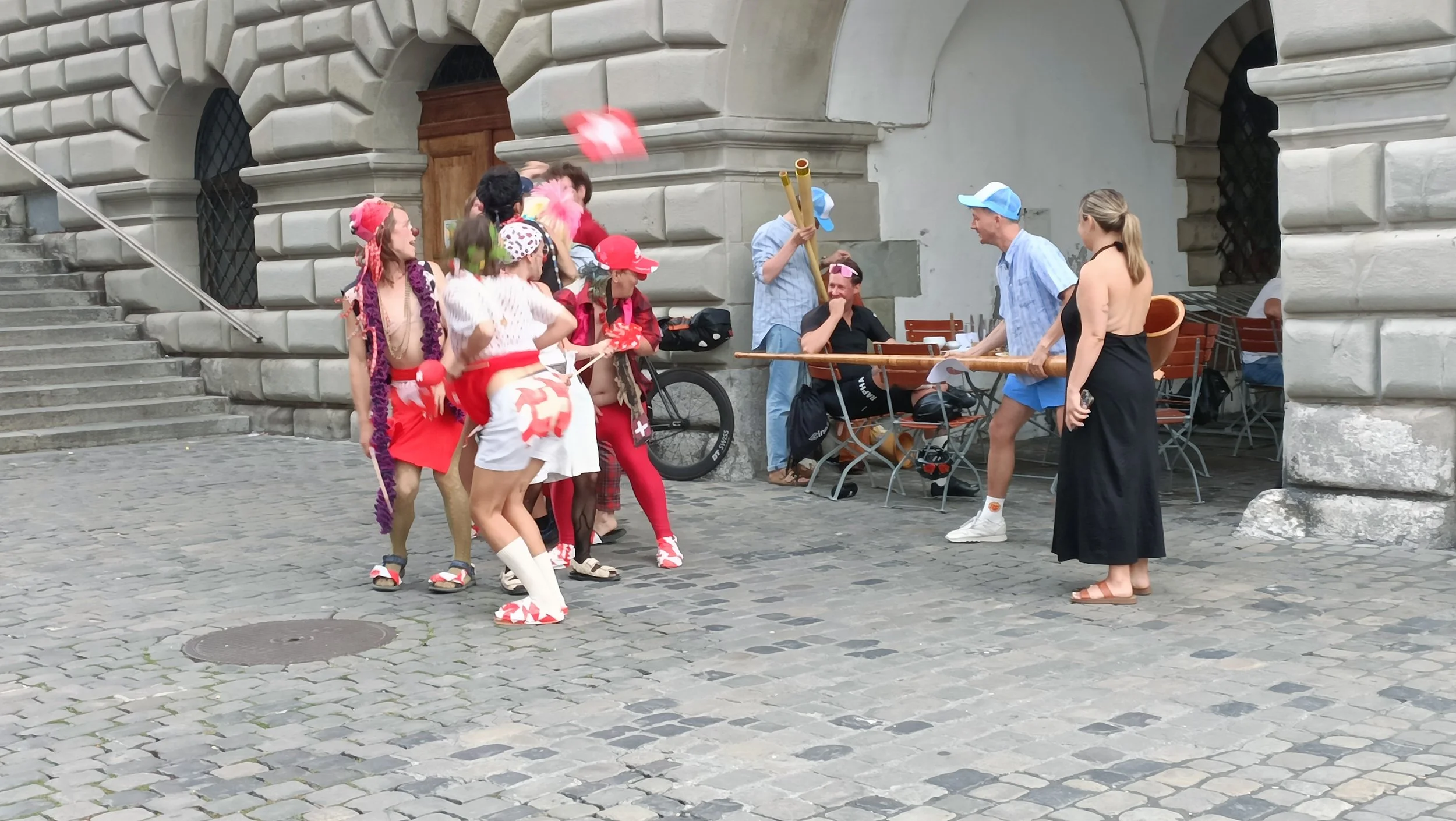
The Happy Meal group march on to the Lowenplatz in Lucerne for their f!easting frenzy
We made time to develop the bouffon work more deeply and participants took to the work avidly, finding a multitude of ways to exaggerate, parody and mock the Great and the Good with passion and a lot of laughter. {I love bouffon}
Ensemble choreographies that are crucial for bouffon work, such as fishing (or flocking) and socking were added to with the Clown-beating-heart and to images coming from themed improvisations on the first day. These elements gave groups a vocabulary of moves, formations and content creation to play with once they had decided upon the action they wanted to develop.
The utopian quality of being experimental, innovative...(Our methodology)
Similar to jazz music, creating a basis of rules and parameters in clowning and bouffon creates room for experimentation and innovations ....and frequently ideas for parody and mockery of the work seeped into the everyday routines of living together.
We were anxious to get into the local town, firstly to feel out different locations, gauge the atmospheres, watch the choreographies of the neighbourhood, and then to see how some low-key experiments might be developed and received. But the time we spent on more intensive clown and bouffon preparation work meant it wasn't until the second NRCA day that we headed into Now Malters is a small, clean, charmingly peaceful, fairly rural Swiss town. It was another hot day in the summer holidays, the streets of the town smelled slightly of warm tar. The church bell chimed four. People were sitting in one or two of the local cafes drinking coffee, beers, walking their dogs. We heard the shouts of young men playing football on the sports field, children were buying ice-cream, travellers were buying train tickets, waiting on the station platform. It all felt particularly calm and leisurely.
Our group of rebel clowns were in town to explore: to listen and observe the choreographies of everyday life, of people and traffic, of street furniture and architecture, of textures, sounds and movements. They were in 'civilian clothes' (ie no costume, no red nose).
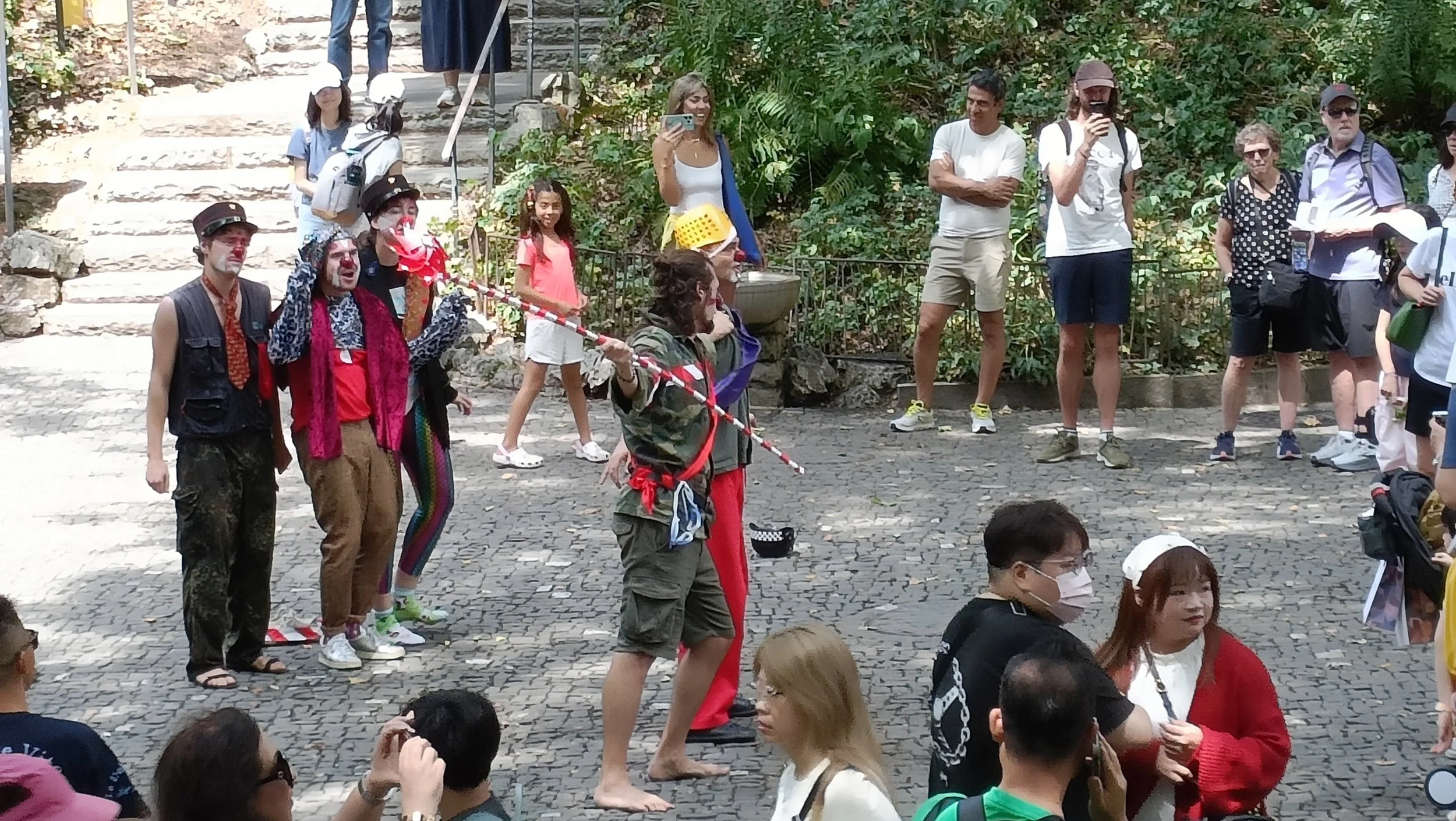
Working in pairs and after initial investigations they began to explore ways of gently disrupting the spaces (with or without red nose) such as: finding unusual ways to cross the zebra crossing (people in Switzerland are very observant and slow right down to let people cross these);
No one particularly seemed to be bothered by acrobatic crossings of the road on hands instead of feet, by clowns directing traffic, or even by the moving of large pieces of street furniture.
Suddenly we noticed two members of the local police standing in front of four clowns who were sitting in a row on a bench.
"You can't do that here, this is a nice town" the policewoman's lips were trembling, she was beside herself with indignation and outrage.
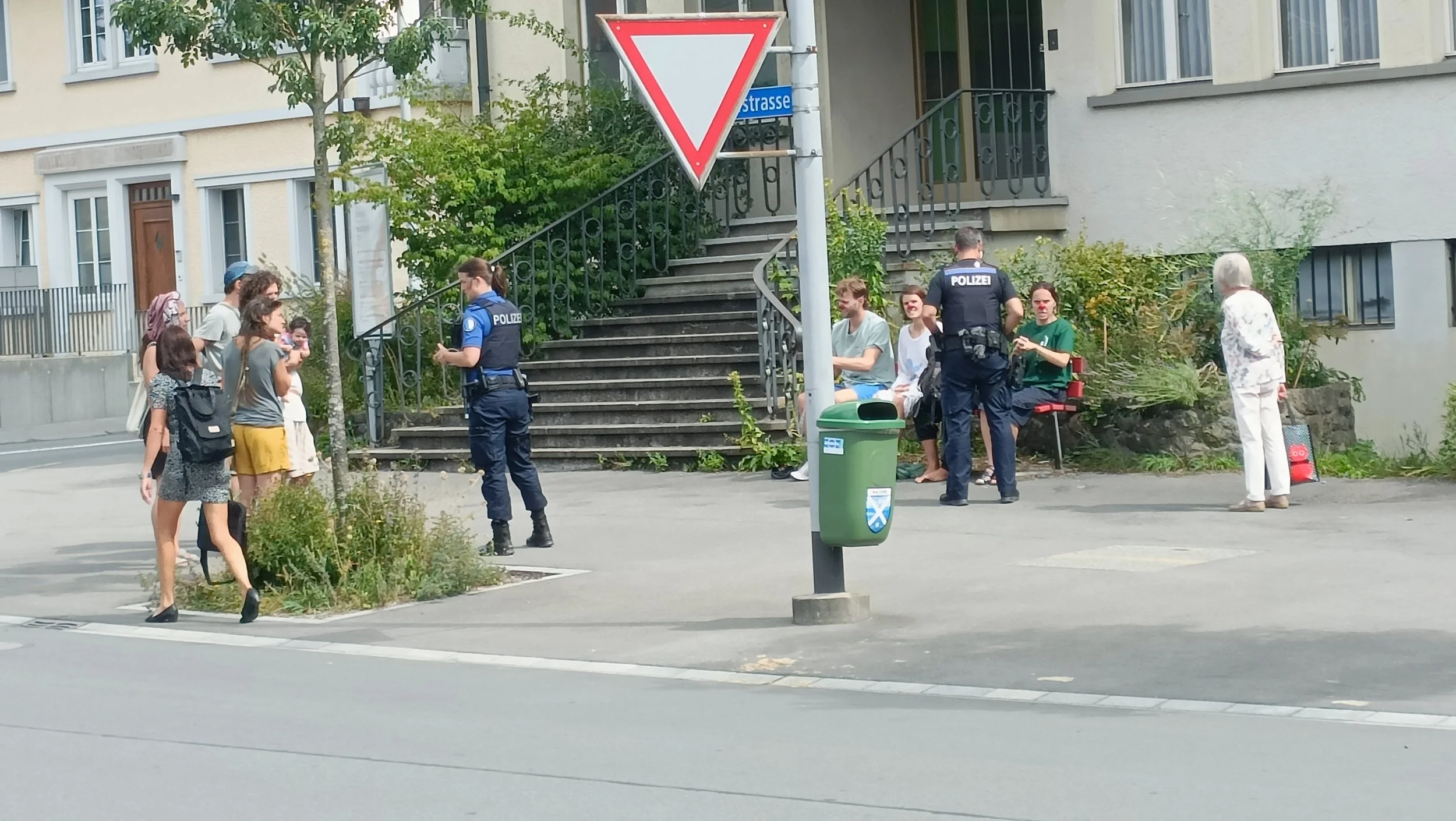
Oops...we had transgressed, gone a step too far, disturbed the smooth waters of this rural town in the middle of Switzerland. Four of the group had taken off their tee shirts and were sitting, bare-breasted on a street bench.
The local police had been informed and were incensed, as well as being completely unprepared in how to deal with a theatrical street action that pushed buttons and boundaries. Clearly they had had no training in how to listen, and certainly no training in how to talk and ask civil questions or even understand something or someone that is outside the norm, something that interrupts the accepted etiquette of this seemingly peaceful locality. They could barely contain the physical violence of their response.
Our bodies had been immediately controlled, alarms had been triggered by three young children who thought that these bare breasts needed to be reported. And reported not to adults, or their parents, asking perhaps why are they doing this, what does it mean...but clearly believing that this kind of exposure cannot be permitted in public space and needs reporting to higher powers. Cultural etiquette that has been transmitted, absorbed and digested at an early age…
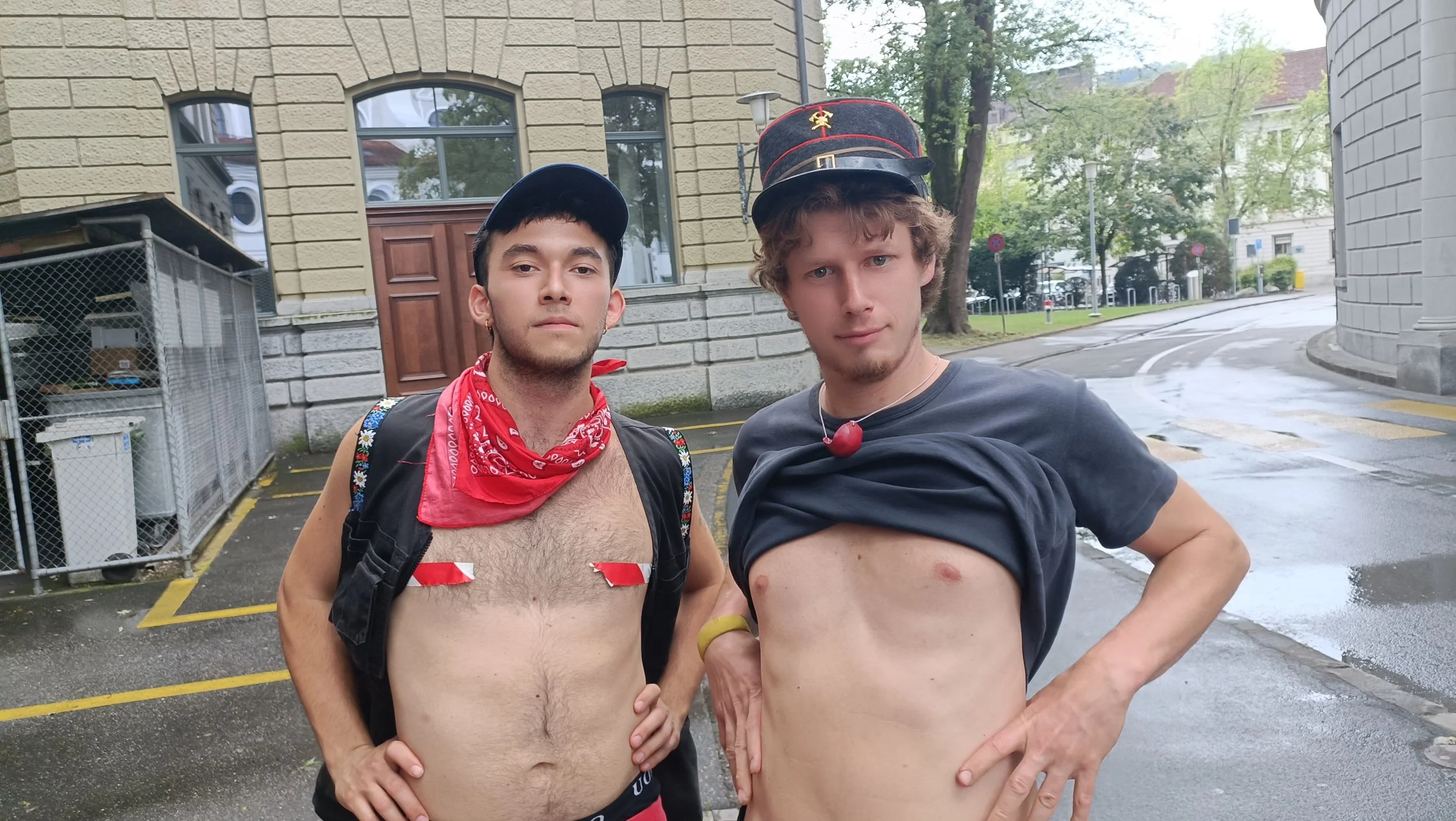
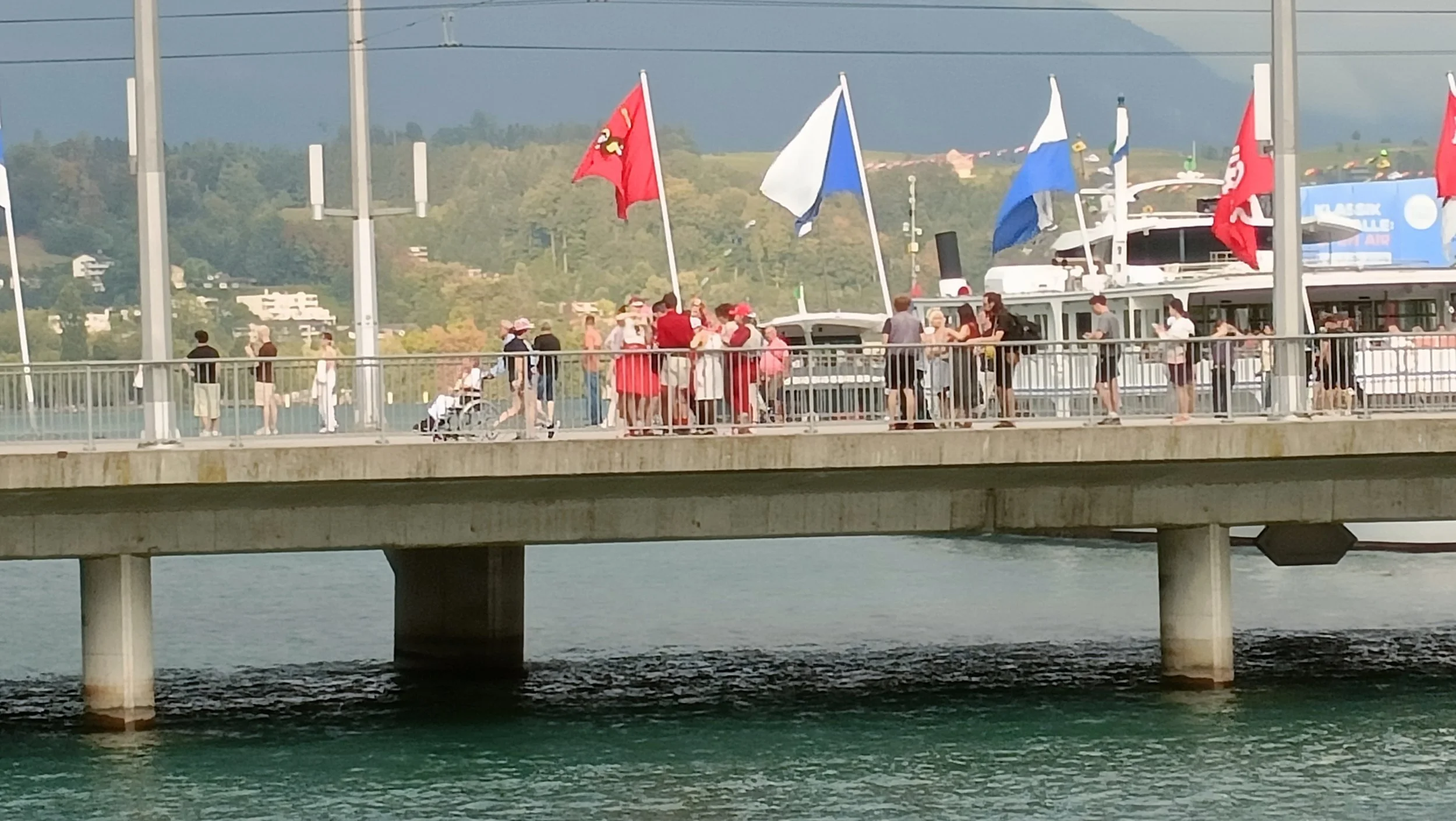
Patridiots showing solidarity in Lucerne after the Bare-Breasted incident in Malters at the beginning of the week
In the end no one was taken to the police station, the incident passed, the troubled waters returned to their normal ebb and flow and the community continued, undisturbed, with their daily routines and lives.
We, on the other hand had a lot to process: the realisation that we had been "seen", that the response to such a "transgression" was immediate and heavy, that female bodies had once again been hetero-sexualised and dominated whilst on the sports field only a kilometre away cis-male bodies were allowed to run wild and free, no restrictions.
So where are the limits of acceptability? Those invisible and unspoken boundaries that we live within, in our communities, villages, towns and cities. Limits and boundaries that potentially protect and hide prejudices, assumptions and age-old attitudes that continue to control and hetero-sexualise ALL bodies.
Could we have responded more effectively by taking on and inhabiting the figure of the bouffon - transgressing and then immediately apologising, transgressing again, and then being extremely sorry to have offended? And repeat…
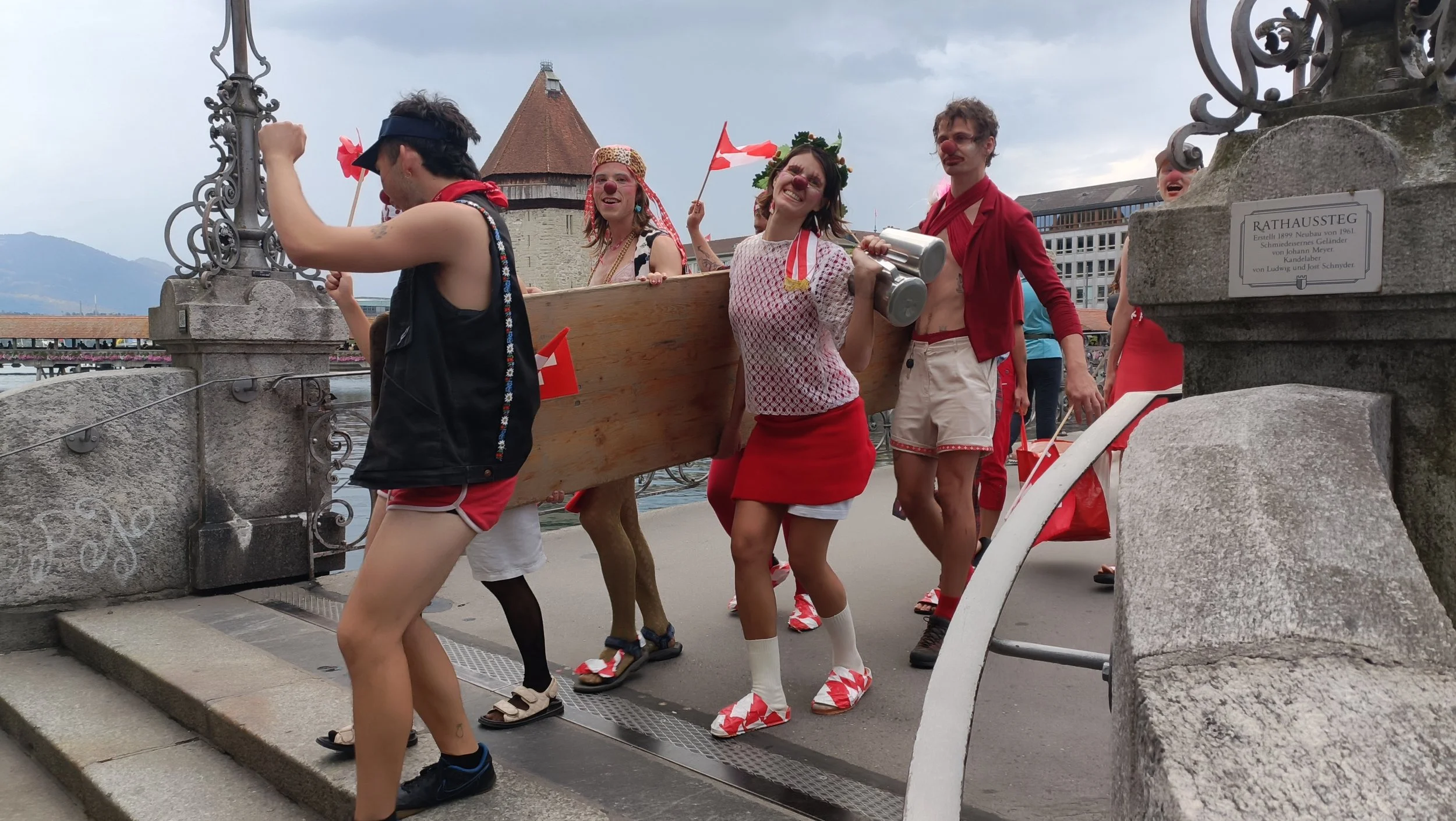
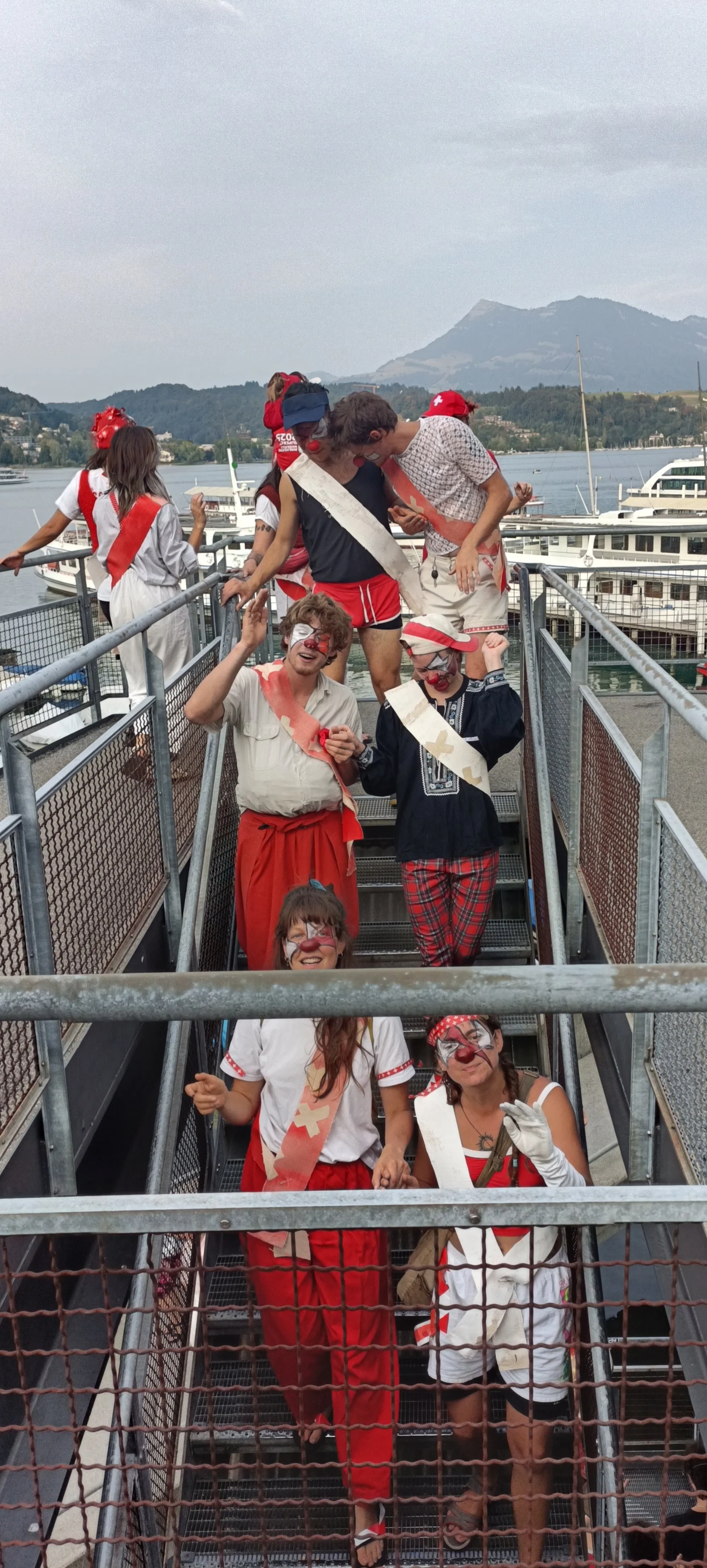
The Swiss Wives…..on edge and over the bridge, unashamedly and unapologetically preparing for another feast…(yes, we loved eating)….
Well, we had experimented, had we been innovative?? Provocative for sure....and simultaneously the four clowns were prefiguring the society they desired, a society where they are also free to take off their tee-shirts and be naked and it is this element which we can analyse and critique further, where the alarms of institutional and systemic forces, not ready for this possibility, are activated and set in motion the termination of such a provocation with immediate and violent response. [rather than go into more detail here I have added a Coda with some further thoughts]
...the everydayness of being imperfect (Failures and upsets)
Yes, not everything ran smoothly: people got tired, needed more space and time alone, fell ill, felt upset, timings wavered, we had to cut short our planned costume and make-up sessions...yet somehow these imperfections, challenges and failures only served to show the flexibility and support of the temporary systems we had created.
Somehow we had not made as much time for repeated iterations of our small street actions (our Quick-Quick-Slow methodology: to try out an idea for an action/intervention quickly and roughly prepare choreography & content; get the work out onto the street, try this out, try that out, try again, see what happens, is there a response, then take a longer time to reflect at the end of several iterations).
Something to consider for our future work, (particularly where we are collaborating with participants who are familiar with each other, and who have already encountered our ways of working) is perhaps to spend even more time watching, listening, observing, chatting to inhabitants, residents, people living and working in the location combining ethnographic and anthropological research with the more embodied work of rebel clowning.
A location with massive geographical proportions and a history of violence meets the rebel clown formation, Happy Meal… what will happen next???
....and being intent on prefiguring a better world (What do we want?)
During this training we were able to experiment and engage further with bouffon work {we all still want more bouffon} adding more games and exercises to give opportunities for exploring its extremes, its nuances and delicate moments. Bouffon affords us wonderful opportunities to impersonate, to mock and parody those we wish to topple from their positions of power, and gives us the power of the group, the community of bouffon. Whilst clown gives us the opportunities to find and explore our curiosity, our questioning and wonder, working more as an individual or in a smaller ensemble. Both demand flexibility, lightness of touch, awareness of and responsiveness to our audiences, our surroundings. And importantly both can offer the surprise of beauty and poetry to stop audiences in their tracks.
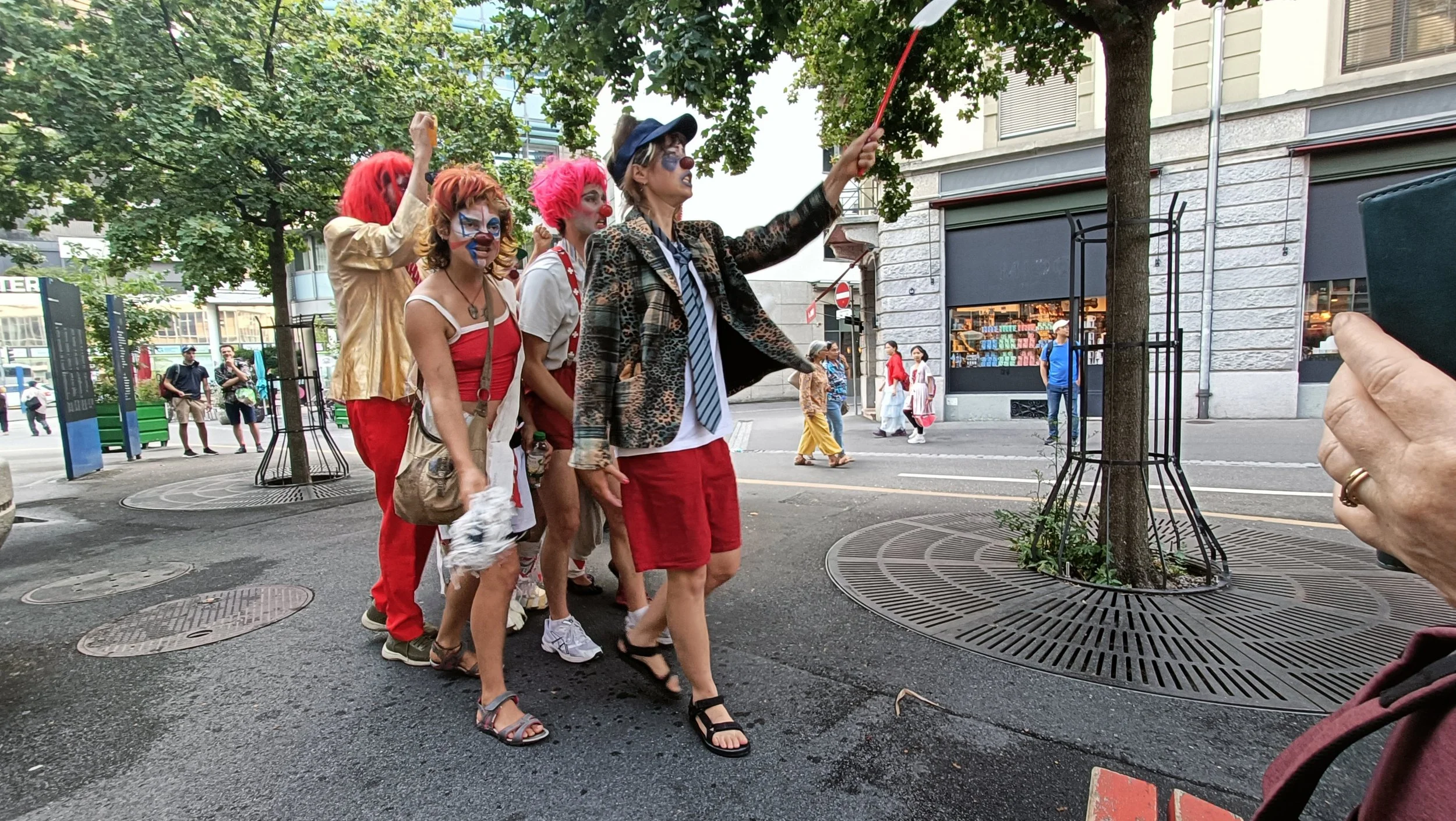
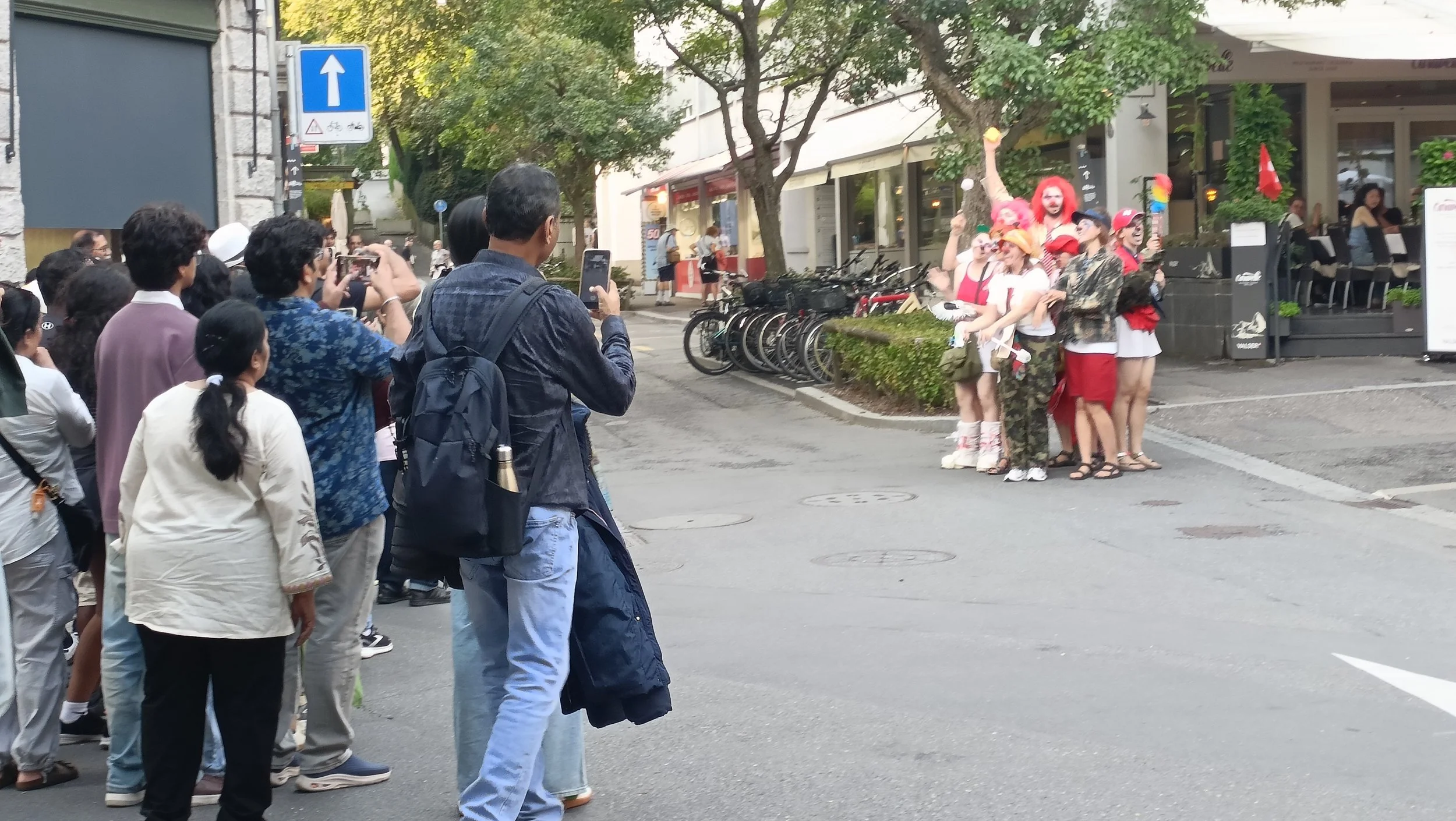
Combining clown and bouffon to create the rebel clown is a tricky process - we are looking for the lightness and naivete of the clown and the street-wise cunning and spitefulness of the bouffon to create this particular and perhaps peculiar mix that can switch from curiosity and playfulness to parody and taunting mockery. Bouffon shows us the underbelly of our societies whilst parodying those who exploit, oppress and cast us out. It is easy (and tempting) to fully engage with the bouffon in a rather one-dimensional way, becoming nasty and mocking without remembering the fear and the motivation to apologise and back off from our targets - the oppressors, authority those who create boundaries, to stick to society's unwritten rules - as well as adding in that layer of playfulness of the clown to create glimpses, examples of how we want our society to look.
Elements that can point to a better world, by showing a different way of doing things. It is this kind of combination that we are trying to develop and of course within this combination there is a spectrum - that can vary from being more clown-like to more bouffon-like, depending on mood, circumstances and audience.
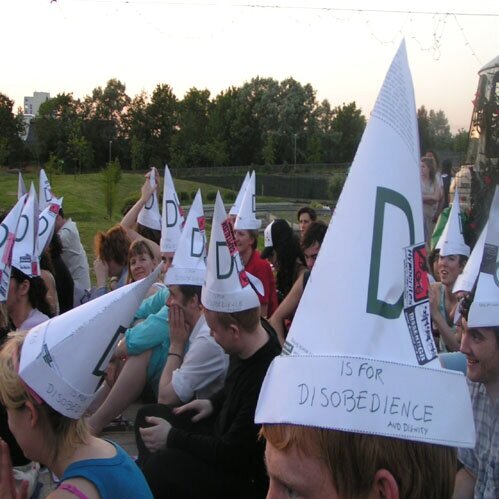
Audience watching CIRCA’s The Ridiculous Recruitment Show in 2004 wearing their Radical Origam-ed hearts.
The rebel clown of CIRCA (Clandestine Insurgent Rebel Clown Army) in 2004 - 5, began as a combination of these two, and it is only now that Robyn and I are taking more time and space to go further in our explorations of this arguably strange mix, to go to its edges and extremes, to see where and how the embodiment of clown and bouffon can work to not only critique and highlight the injustices and inequities of our life-worlds but to also prefigure, to create imaginings of how we want to transform these worlds and to realise some visions of alternatives for ourselves and our audiences.
[Coda: The personal...
That was the second full day of our workshop and although we had begun to engage more deeply with bouffon we were still in the beginning stages of our work outside on the streets, still in the initial stages of observing and experimenting with low-key interventions. Perhaps this intervention wasn't as low key as it could have been, but it wasn't an aggressive intervention. Certainly the interruption of bare-breasted women in public space was, and is, provoking. However, they were not walking around the town or 'parading' their nakedness; they were still, sitting on a bench, observing their surroundings, leisurely taking in the choreographies of that public space in the warmth of an afternoon. And was I, were we, overreacting in our feelings of anger and deep sadness?
...is still (always) (immer noch) (encore) political
.....Another sunny, warm day in the school holidays, 1965, Devon England. We were playing in the garden four or five boys and girls, neighbourhood friends, the lawn was slightly damp, some of us were dressed in only shorts. My favourite yellow tee shirt, slightly crinkly, with an open collar was lying, discarded in the heat on the grass. My grandmother was close to me as I was kneeling over looking at some insect in the grass. I'd just had my 12th birthday and she said something that made my heart sink, my stomach tighten: lightly touching the middle of my back where a bra strap would be, she said: Soon you won't be able to go around like this: I looked at my friends and knew that something was changing, a shift in my world and it would never be the same again. I knew in that moment that I really was different from the boys, they would have a freedom and sense of bare-breasted confidence in the world that I would never experience - this was the last summer I'd feel free to just take off my shirt and expose my body to the sun, wind, rain.....
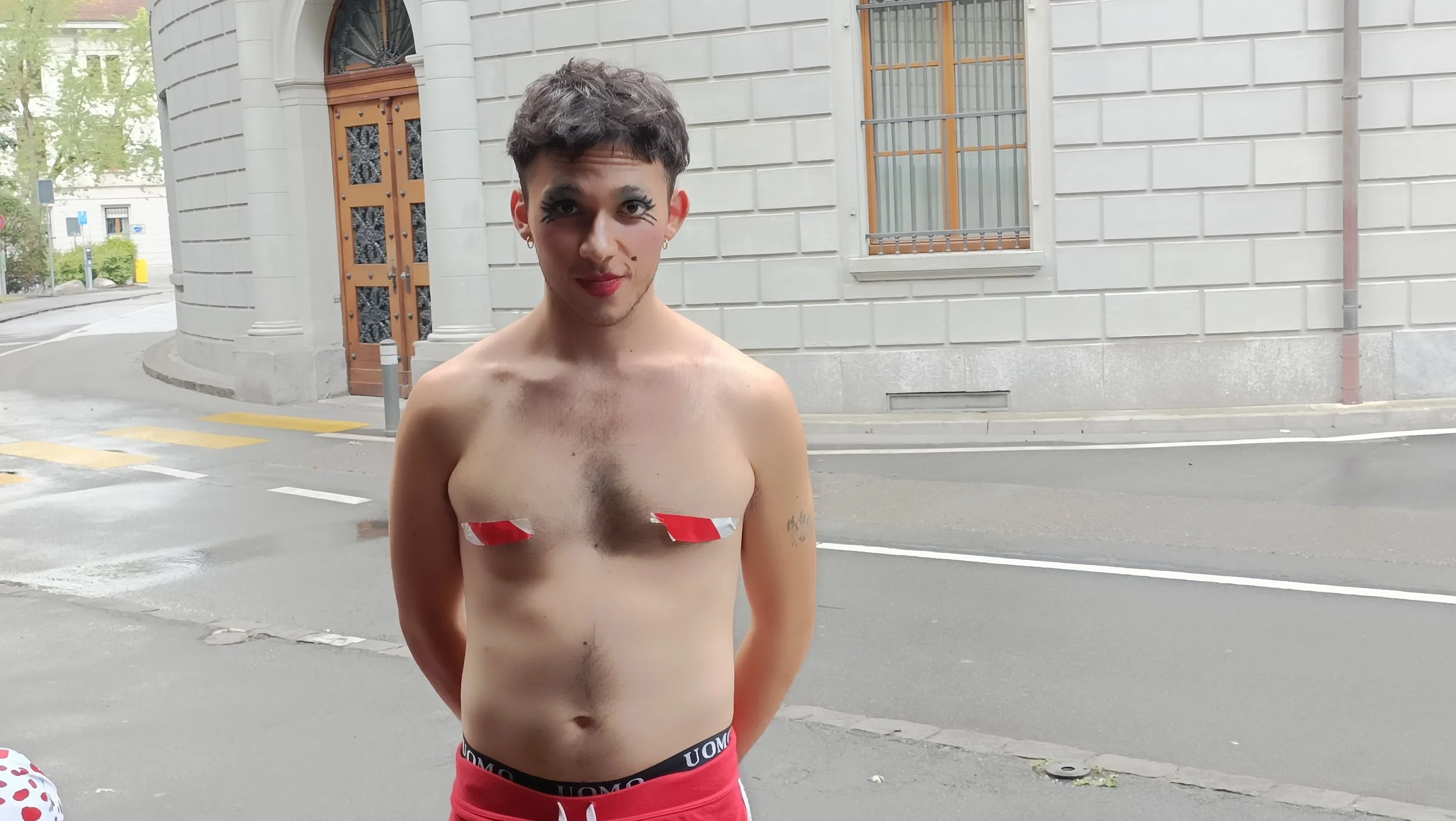
Finding ways to disrupt and interrupt the assumptions of what we can and cannot expose, what we show and what we don’t show, on our bodies
The theme of female bare-breastedness became a bit of a continuing reference during the rest of the training and our cis-male participants were made aware of the accepted inequity of being able to just strip off their tee shirts at any moment they chose to. They agreed that they would remain clothed unless everyone was able to take off their tops. And these were spoken agreements, adjusting behaviour and the cultural etiquette of our temporary community for the benefit of and to include all. Unlike the response we had encountered in the town which was clear and drastic punishment for transgression of the community's unspoken rules. Cooper also discusses ‘nakedness’ in Chapter 5 of her book in the context of the Toronto Women’s Bathouse.]
After-thoughts, after-feelings
I'm left with deep feelings of gratitude for the many elements that our temporary community created over the 10 days we were together: Flexibility of minds, bodies, emotions and spirits which allowed for little and temporary diversions from the conformities and parameters that are necessary for group living; Exposure to nature everyday with the possibility to spend time alone there, to work, play, eat and chat together on grass, under trees, to swim in the river; The opportunity to experience each individual's gifts and contributions to the others, and to group living; The daily buzz of creativity, ideas and excitement that accompanied games and exercises, dancing and music, muscles moving; The growing passion for change and transformation of ourselves and our worlds, that gives me ideas for new and wild exploits ahead; And perhaps most of all, for the hope that emerged everyday from seeing new generations of clowns and activists, rebels and radicals with glints of mischief and mockery in their eyes and fire in their bellies.
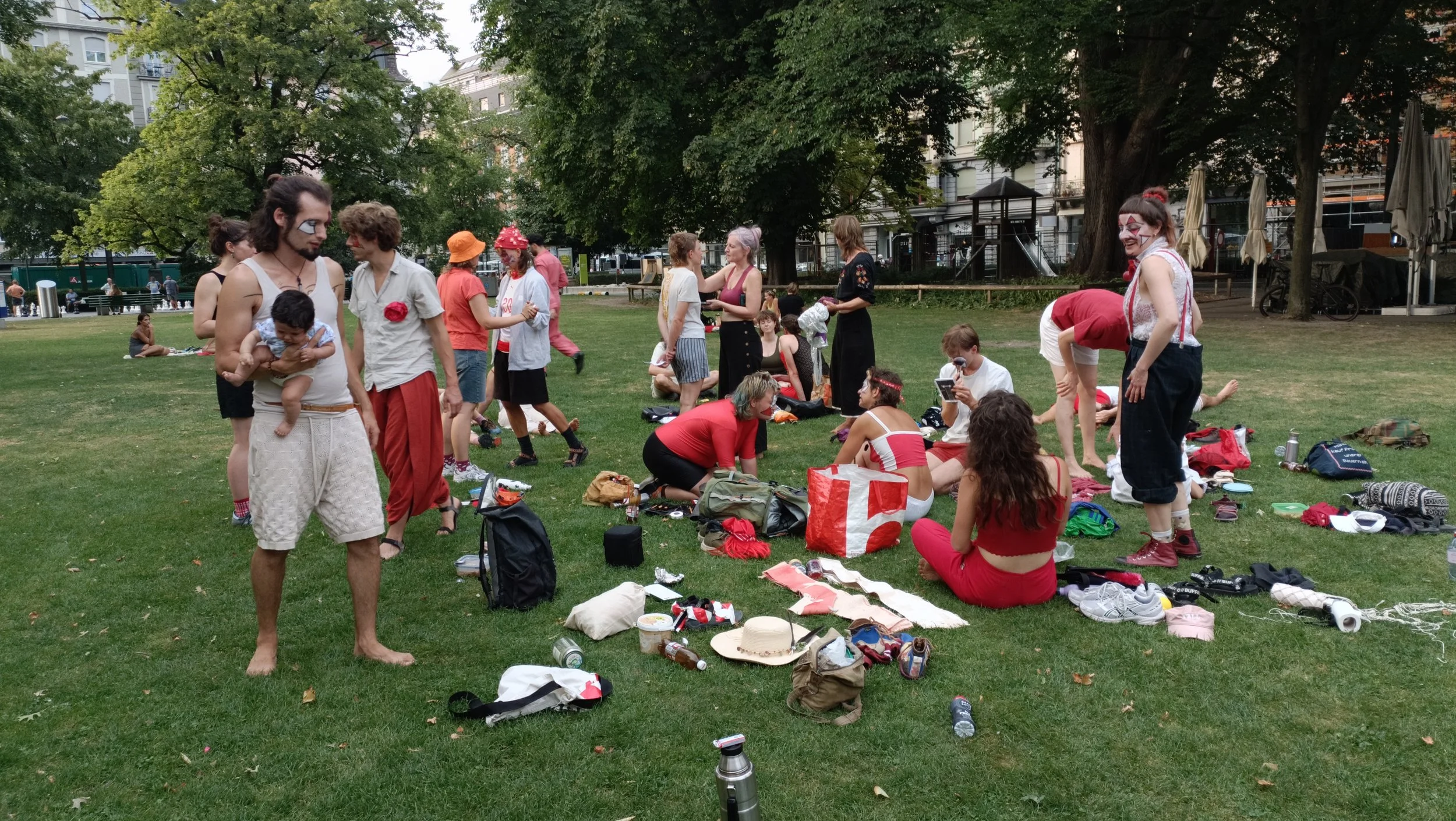
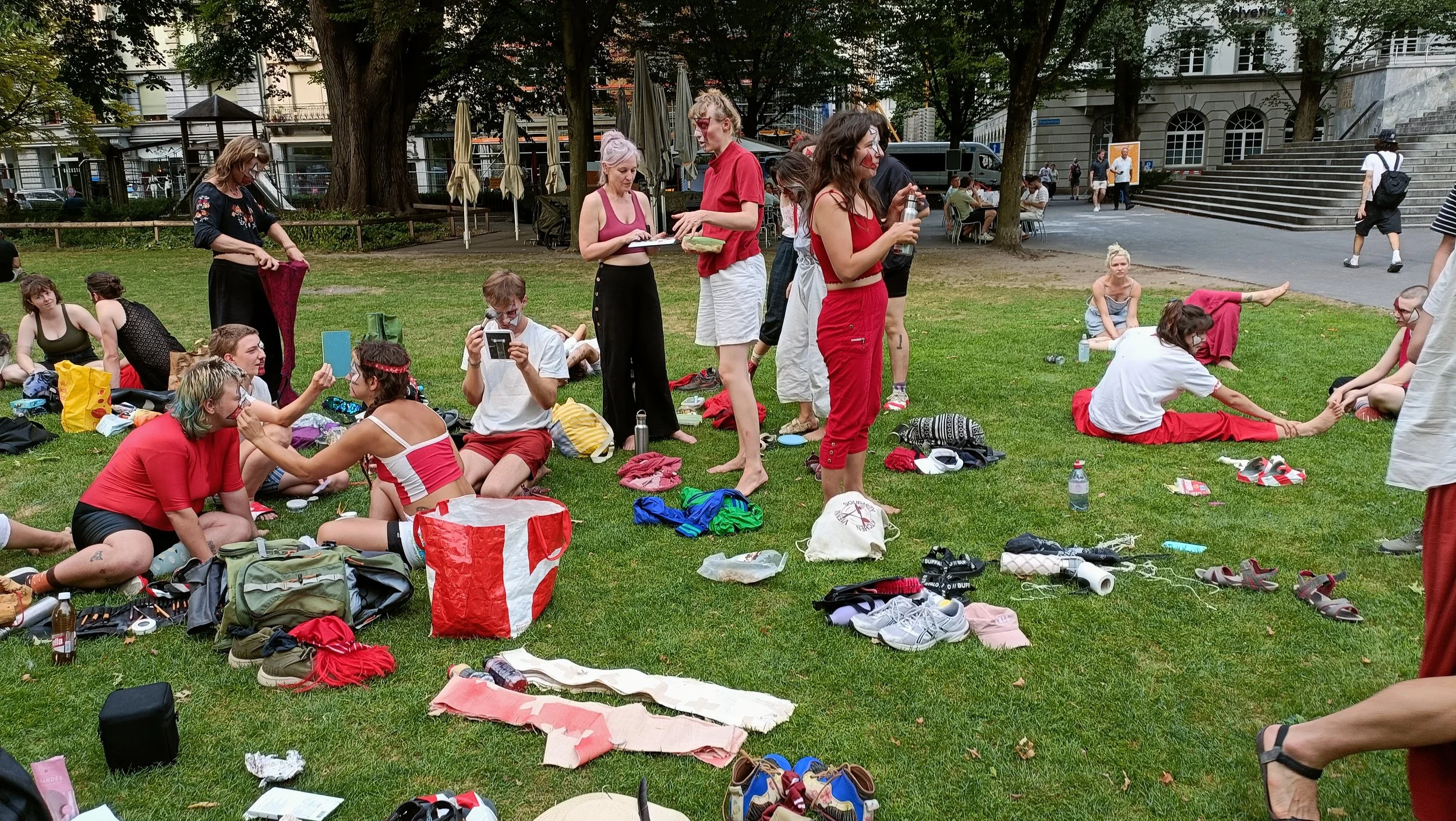
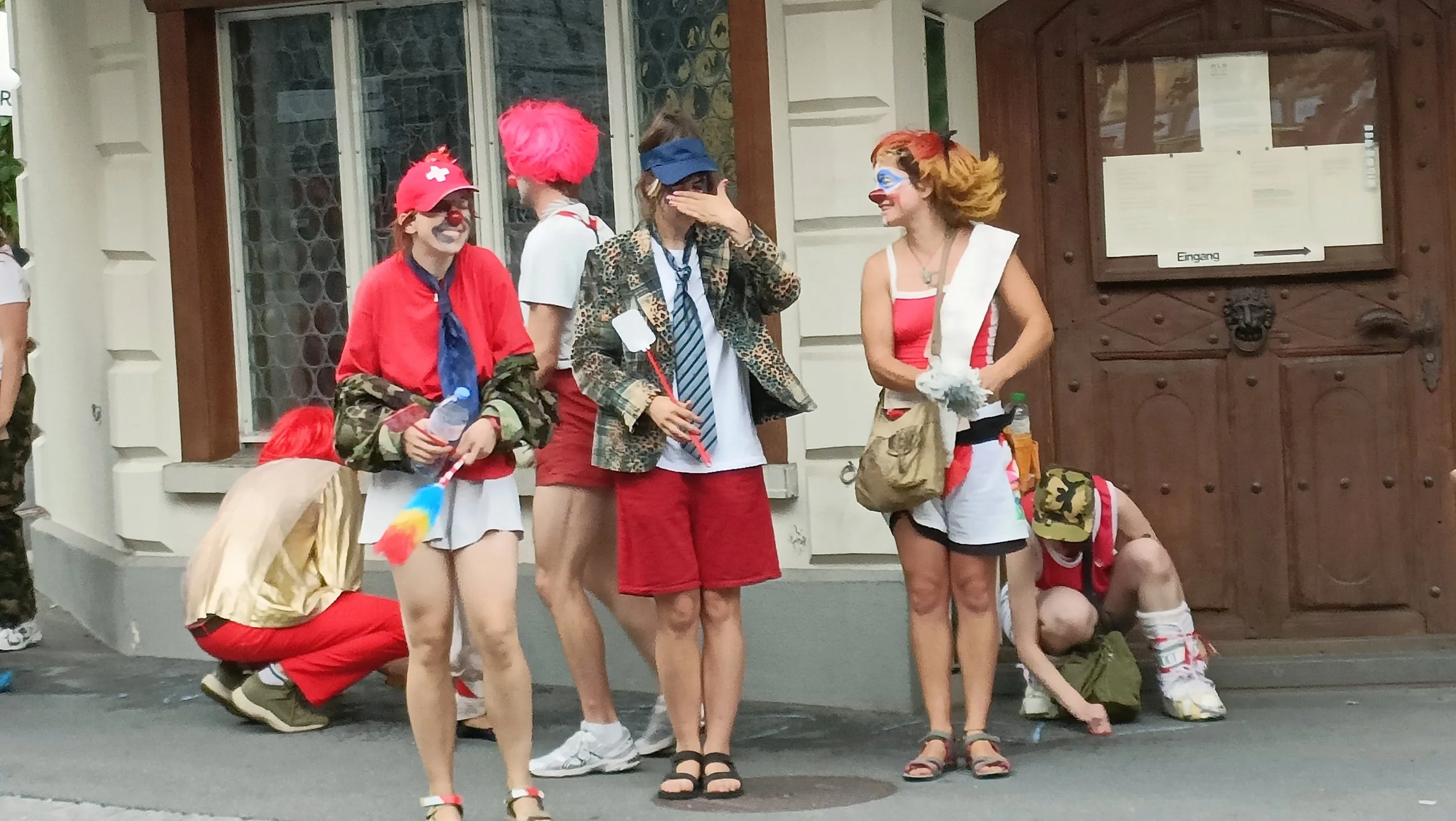
Getting ready in Lucerne for Patridiot parades through the city.
How do we carry these temporary spaces of transformation and change into our other everyday lives, into the lives of others who we share this world with? Our work (and play) lie before us….
In the meantime....I've got an idea...Let's do it again!
References: 1 & 2 from Cooper, D (2014) Everyday utopias- the conceptual life of promising spaces. (USA: Duke University Press)